🎙️Transcript: Startups Unedited
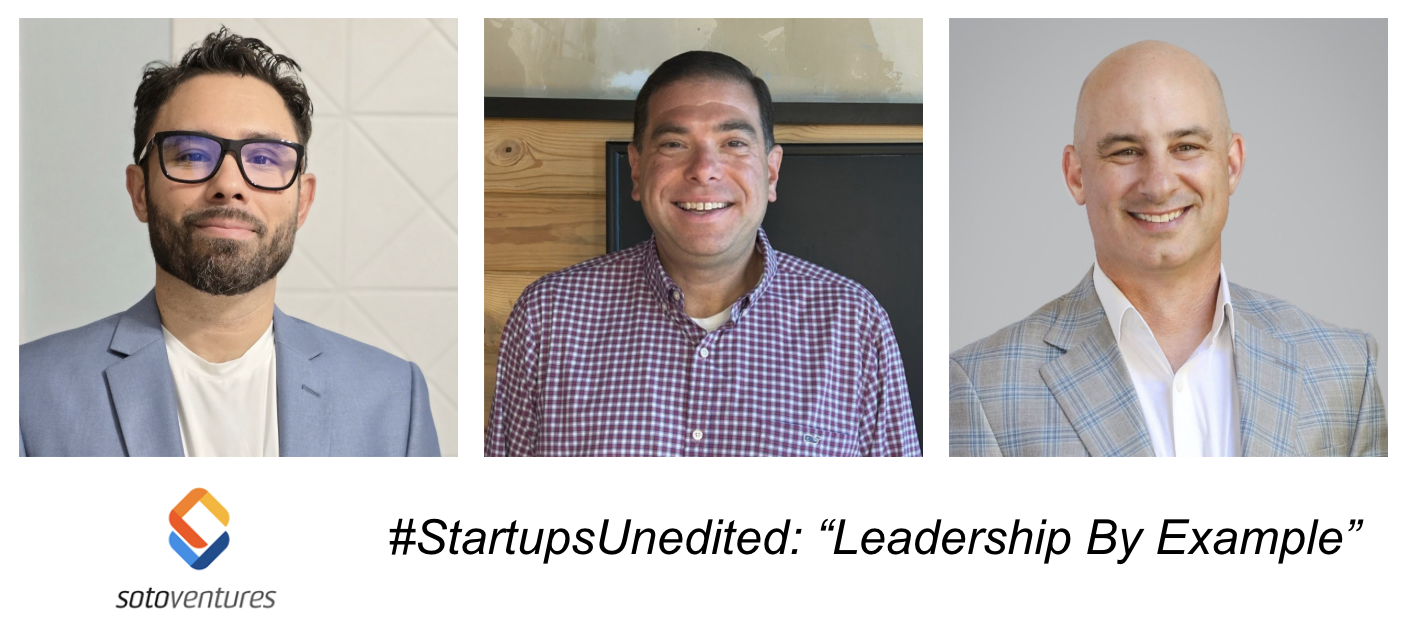
#StartupsUnedited
"Leadership by Example"
Jorge Soto, Mark Ruthfield, Ralph Barsi
April 22, 2016
Summary
In this episode of Startups Unedited, host Jorge Soto sits down with Ralph Barsi (Global Sales Development at ServiceNow) and Mark Ruthfield (VP of Sales at Yesware) to explore authentic leadership through service, mindfulness, and transparency.
The conversation centers on what it means to lead by example and empower teams to achieve both personal career growth goals and business objectives.
Ralph emphasizes leadership as service, encouraging leaders to be present and mindful while drawing out the unique strengths in each team member.
Mark shares how his father's 30-year career in education shaped his approach to leadership, advocating for transparency, accountability, and clearly defined core values.
Both leaders stress the importance of leading from the front, never asking teams to do what they wouldn't do themselves, and creating win-win outcomes where individual and company goals align.
The discussion offers practical guidance for startup founders and established leaders alike on building service-oriented cultures that prioritize people development alongside business results.
BIG Takeaways
Leadership Means Service, Not Authority
True leadership isn't about pushing people toward goals but pulling them forward through service and empowerment. Leaders who make the greatest impact focus on exposing and developing each person's unique gifts and strengths.
This servant leadership approach creates exponential impact, as evidenced by the hundreds who attend a great leader's funeral, showing the lasting influence of those who dedicated themselves to serving others.
Mindfulness Starts With Being Present
Effective leadership requires being fully present in the moment rather than anxious about the future or depressed about the past. Start by "putting a 10 on their forehead," giving team members the benefit of the doubt and recognizing that everyone has their own story and narrative.
When leaders stay present and mindful, they can draw out the best attributes in people, helping them discover strengths they didn't know they possessed.
Transparency Creates Win-Win Outcomes
When leaders operate from a win-win mindset, ensuring outcomes benefit everyone in the process, transparency becomes easy and natural.
Clear, specific communication about what needs to be accomplished and why creates a groundswell of effort toward common goals. Transparency about company direction, sales processes, expectations, and accountability standards eliminates gray areas and builds trust across teams.
Lead by Example Without Exception
Never ask your team to do something you wouldn't do yourself. Leaders must roll up their sleeves and demonstrate the behaviors, activities, and standards they expect from others.
Whether it's making prospecting calls, using new communication tools, or adopting different processes, leaders who model desired behaviors earn credibility and respect that commands from a distance never will.
Personal Career Growth Goals Drive Company Results
When leaders prioritize helping team members achieve their personal career development objectives, company goals naturally follow.
Take time to understand each person's individual strengths, improvement areas, and aspirations. Create concrete plans to help them get there. This investment in individual growth creates loyalty, engagement, and performance that directly benefits business outcomes.
Don't Label People, Leverage Their Strengths
Avoid categorizing team members by generation, background, or demographics. Instead, focus on identifying and leveraging each person's unique strengths for the business.
Someone with a short attention span might excel at quickly sorting through waves of information. Those more digitally savvy can teach leaders new approaches. Position people where their natural abilities shine rather than trying to force them into predetermined boxes.
Establish Core Values and Lead From Them
Identify and articulate the five to seven core values you want instilled across your organization, not just within sales teams.
These values should guide decisions, behaviors, and expectations from the top down. When combined with accountability standards and clear expectations, core values create a foundation for culture that transcends individual departments and unifies the entire organization around shared principles.
Transcript
Jorge Soto (00:02):
Hey everyone, this is Jorge Soto and you're watching Startups Unedited. Hey everyone, this is Jorge Soto with Soto Ventures. Hope all is well and hope everyone's having a fantastic morning. I am absolutely elated to be joined by Mark Ruthfield, who is the VP of Sales at Yesware in Boston, and my very dear friend, Ralph Barsi, who, Ralph, now you're running global sales development at ServiceNow in the Bay Area, is that right?
Ralph Barsi (00:37):
That's correct. Happy to be here.
Jorge Soto (00:40):
Thank you, Mark. How are you?
Mark Ruthfield (00:42):
Excellent, Jorge. Great to see you guys, and very excited for this conversation.
Jorge Soto (00:48):
Fantastic. So today we're going to really be talking about leadership, of course. However, how do you empower and inspire our reps to be great, Ralph? We've talked a lot about the notion of really being a mindful leader, mindful manager. Before we get into that, why don't you just kind of quickly give the audience a quick background on yourself?
Ralph Barsi (01:13):
Sure. Happy to. I'm Ralph Barsi. I oversee the global sales development organization at ServiceNow today. That's comprised of about a hundred people in seven offices around the globe. I am based in the Bay Area here in Silicon Valley. I've been in sales for about 23 years now. Half of my career has been spent as an individual contributor, and the other half has been spent building and leading sales development teams in particular. So that's a bit on my background. Personally, I've been a drummer my entire life. I love music. I'm a family guy. I've got a wife celebrating 20 years of marriage this year, and I have three boys, and life is good. No complaints over here.
Jorge Soto (01:59):
Awesome, Mark.
Mark Ruthfield (02:02):
Yeah, yeah, I'd love to share a little bit about myself as well. So I've been in sales for over 20 years. I came over to Yesware back in September of 2015. Prior to that, headed up sales over at Zoom Information. I've been very active with the American Association of Inside Sales Professionals, proud and honored to have won that top 25 prestigious award. We've actually got a lot going on here, doubled in our sales team since September. And why this topic is really of passion to me is actually my father who had passed away last June due to cancer. He was in education for about 30 years, and I saw him go from a teacher to assistant principal, principal, assistant superintendent, and then superintendent most recently of Ashland Public Schools in Ashland, Massachusetts. And as a kid, I used to go to his school and play basketball while he helped teachers and administrators.
(03:05):
And I just saw the effect that he had on people that he worked with and helped that. And at his funeral actually, there was over 400 people and just seeing the impact that he had on people's lives. That's really what I've taken on from his leadership with my teams in sales over the years and why I'm so passionate about leadership and personal career growth goals. And I feel that if you can get the personal career growth goals taken care of, the company goals follow. So just a little background as to why I'm so passionate about this topic.
Jorge Soto (03:39):
Awesome, Mark, thank you so much for sharing that. And of course, my thoughts. What is leadership at its core? I've been asking this question now for the last year or so, have done some content and have interviewed some folks, but what is leadership at its core, irrespective of what we do as a career?
Ralph Barsi (04:04):
For me, leadership means to serve. So in the example Mark gave of his father, your impact is exponential. And at your funeral and at your memorial, when you have hundreds of people there showing the impact you've made in their lives, that comes from service and being a servant to them and giving everything. You've got to basically empower them in their own lives to expose their own unique gifts and strengths. So that's how I've always seen leadership. It's somebody that pulls a team towards a goal versus push them. And I think everybody's got the will within them, and it's up to the leader and the strong leader to tease that out of each individual.
Jorge Soto (04:49):
Now, Ralph, you and I have talked about how do we actually condition ourselves as managers, as leaders of groups, to be mindful, to be service oriented, to be in a position to serve and empower and inspire our reps or the folks that we're given an opportunity to lead or work with. How do you start to do that as a leader, as that individual?
Ralph Barsi (05:20):
Sure. So it starts from within you. First and foremost, just being mindful is about being present. It's not about being anxious about the future and being uncertain about what's to come. It's not about being depressed about what has happened in the past. Instead, it's just about being present to the moment. And also with respect to the people around you that you're serving, start by putting a 10 on their forehead and giving them the benefit of the doubt. Everyone has their own story and their own narrative, and you just have to be mindful and present of what that story is and stay in the sunlight and try to draw out the very best attributes of everyone's narrative and help them find it themselves, because a lot of people don't know that they have it. So if you're present to them and present to the moment, you can help draw it out of them.
Jorge Soto (06:13):
Thank you for that. Mark, what are your thoughts around that?
Mark Ruthfield (06:17):
No, I couldn't agree more with what Ralph had said. Very impressive, obviously, why he's so successful in leading his team there. I'm a big fan of basically everyone has different strengths, different areas for improvement, different personal career growth goals. I think it's really just taking the time to have those discussions to see what those are, and putting together a plan on how to get there and achieve them. And I think as leaders, one of the things I've always tried to do is really just simplify everything we do in our day-to-day. And with regard to sales, specifically across the sales process, I mean, how do you just make things so repeatable across the entire sales process and just have structure and best practices in place when there's something gray, make it black and white whenever there's an end goal in line, be transparent about things. Ralph had talked about being mindful and present. I'm always a big fan of just being completely transparent on what we're trying to do. And then really just utilize your leadership team as well as what I call sales dream team and just find ways to get there together. But transparency has always worked for me.
Jorge Soto (07:39):
Transparency is a powerful topic. What does that mean in regards to the day-to-day, day operations or communications of your team? And so to elaborate, sometimes there are things that you sort of sit there and you say, is this something that I can share with my team? Is this too much? Am I going to be sort of maybe too forward or too direct with rep A who's maybe not doing as well? How do you sort of understand what's too transparent or what's too raw or too direct?
Mark Ruthfield (08:25):
Yeah, yeah, absolutely. Oh, go ahead Ralph. No, no, go ahead.
Ralph Barsi (08:29):
I was just going to say, if you're of the mindset Jorge of win-win and making sure that the outcome that everyone is after benefits everybody in the process, then it's very easy to be transparent. So for example, you talked about day-to-day operation. If the leaders are very clear and very specific in their communication efforts via email or on an internal conference call, et cetera, about, hey, we need to knock this out. We need to embrace the day-to-day grind in order to get to this outcome where everyone will win, in the end, you'll get a groundswell of effort working with you towards the same common goal. And that has worked for me time and time again. I find that being transparent and exposing yourself to the outcome that you're after really helps everybody win.
Jorge Soto (09:24):
Got it. Mark, what's your take on it?
Mark Ruthfield (09:27):
Yeah, yeah. So I think that in today's world, right, there's so many times when individuals that are on sales teams know what is and isn't good for the company, what's working and what's not working. And when you have someone on your sales team that's been in sales for maybe 10, 15, 20 years, there's a lot of reasons why they've seen that work, where it doesn't work, and they actually know more than you as a sales leader sometimes. I think just being completely transparent and using an open door policy where it's like, look guys, this is what we're trying to do. We might not always have the right plan in place, we might not have the right process in place. It's here's where we're trying to get, everyone aligned on that and find a way to do it together. I totally think that there's obviously different leadership styles, but when you manage by fear or if someone's not reaching their quota to the outside public, you're like, oh, well they're not hitting their number and these are the areas they need to develop and this is why they're not doing it.
(10:25):
That just creates so much fear. And I think it's really just, hey, we got this together. Sales is a team sport, everyone has different strengths, everyone has different things that they bring to the table. And I think that's really just working together to find out what that is and utilize it for success for everyone, not just the salesperson that's maybe not hitting their numbers or the salesperson that is hitting their numbers. But taking what someone that is hitting their numbers is doing, helping other people get there as well. And just finding a way to do it all together. So transparency, being open and having an environment where it's safe to not only succeed but also fail has just worked very well for us here.
Jorge Soto (11:12):
Fantastic. You both touched upon leading by example. How do you as a leader, Ralph or Mark, how do you as a leader lead by example and not necessarily be almost like a pusher or kind of maybe perceived as a dictator in regards to our beliefs, our processes, our values as a leader? How do you bring that into a company, into a team and do it by example without being looked at as somewhat pushy?
Ralph Barsi (11:50):
Sure. Great question. Part of it, at least for me, is I've rolled my sleeves up my entire career and to this day I'm still rolling my sleeves up and jumping in. I would never ask a team member of mine to do something that I wouldn't do or haven't done myself. So it's really important to me to be in the thick of things and be able to roll with anyone on my team and say, hey, watch me make this call. Hey, watch me send this email. Hey, watch me schedule this meeting for you. It's just leading from the front. And I think that's the definition of what it means. And it also, when you're doing those kinds of behaviors and you're spending time that way as a leader, it injects a lot of energy into your team and gives them the certainty that we're going to get to where we want to go. And my role as a leader for you is to be a certain person who knows the path and can take you down the path. And we're going to do this together. So that's just what I've always done.
Jorge Soto (12:46):
Got it. Mark?
Mark Ruthfield (13:22):
Yeah, yeah. So great, it's a great question. So I couldn't agree more with Ralph on leading by example. And I think an example of when I came into Yesware, they were really using these instant message things heavily in communication, whereas I haven't done that in the past. So that was me adapting to the style of communication. But I think you have to share why things are important. We really put a new organizational structure in place, really put sales process and best practices in place from A to Z together. And I think it's showing them what they've been doing in the past as good, but there's better ways to do things, show them how to do it. And an example is with our SDR team, we do a lot of the Jeff Hoffman, John Barrows, the Beeyu now, the AA-ISP show, the Kenzie partners. And we've taken it actually to a high level leveraging our investors, our executive team, our advisors to broker introductions to our company personas and the buyer personas at those companies. And we really utilize social media in our outbound prospecting and how do you rise above the noise? And that process wasn't here before I got here. So I think it's really taking the time to understand why people are doing what they're doing. And then just like Ralph said, I would never ask my team to do something that I would not do and actually lead by example on that. And we've totally changed and we've gone from setting up, we've tripled our buyer conversations from our outbound SDR team over the last three months through this process.
Jorge Soto (15:10):
I would argue that you're on this show this morning leading by example, so thank you, Ralph. How do you connect with millennials? How do you as a leader now get the best and inspire and empower these folks?
Ralph Barsi (15:31):
Yeah, so first of all, I don't label them. I don't look at them as millennials. They're people. And if it's a person with a short attention span that's really hip in digital technology and more hip than me, this is somebody I can learn from, and these are strengths that I'm going to leverage for our business to move us forward. So if I happen to be dealing with somebody who has a short attention span as a leader, I'm going to have them focus on tasks that bring them from point A to point B versus point A to point Z. And I'll make sure that we're hustling and we're taking advantage of their short attention span. And there's so much we're overwhelmed with today in terms of information and insights, and it's just coming at us in waves and it's the quote millennial, or it's the person with that short attention span that is likely a lot more nimble that can sort through that wave of information and insights a lot faster than maybe I can. So I'm going to put them in a spot on our team where we need those strengths, and I'm going to make sure that they shine. I'm not going to look at them as, they're not the same generation as me, frankly, I don't care. I'm going to utilize the strengths that they're bringing to the table to better our business.
Jorge Soto (16:55):
Awesome. Awesome. Well, guys, I know we're running up on the hour if you are a startup founder, because on this show we focus on the entrepreneurial experience, of course, leadership and empowerment and these other business topics are absolutely applicable to the entrepreneur, whether it's they one or they thousands of their business. If you were a founder trying to think about how do I actually develop a service oriented, service-minded leadership program here, or leadership culture, what are one or the two tips that you would provide this founder with? So again, how do we start to develop a culture around leading by example, all the things that we talked about, empowering, being compassionate, being mindful. Mark, maybe you can kick it off just again, what are one or two tips?
Mark Ruthfield (17:59):
Yeah, so I think that what we've done here at Yesware as an example, so we actually have five Yesware core values. So actually identifying what those core values you want to have and instill not just on a sales team, but from the top down across all areas. So I think if you can identify what the values are that you want to get out of each and every person at your firm, I couldn't recommend starting there and haven't always had that in the 20 plus years of sales that I've been in. And it really resonates here. And I think it's really, again, leading by example. You need someone that heads up sales or that's done this before that's rolled up the sleeves. So like we've been talking about leading by example and really just showing people to focus a hundred percent of their time and activity on what we can control. Being able to look ourselves and our peers in the eyes before we leave every day, have that accountability, the expectations, and obviously you want to have a good organizational structure from a support standpoint, good process in place, but I think the values, the accountability, and the expectations is what I would recommend.
Jorge Soto (19:15):
Fantastic. Thank you so much. Ralph, what are your thoughts?
Ralph Barsi (19:18):
For me, any entrepreneur is impressive to me, and I'm amazed by the moxie that it takes to be an entrepreneur. So my hat's always off to entrepreneurs, and if I can shed any light, not even being one, what I see, the ones who are succeeding are the ones who are really present to the marketplace and listening to the marketplace, because it's the market that really pulls your business where it needs to go. So just be aware of the marketplace, listening to it and being ready to make adjustments and course corrections. You have to be listening closely enough to know when it's time to maybe make a change. I also think that to quote Gary Vaynerchuk, you got to really triple down on your strengths and not focus so much on your areas of improvement or your weaknesses. Do what you do great, because we the marketplace, we need it, and we need you to show us what you've got. So that would be my advice for entrepreneurs starting out or just on their own continuum right now, is to keep those components in mind.
Jorge Soto (20:31):
Fantastic. Mark, if folks want to get in touch, contact with you, want to get in touch with your tweet, Facebook, what's the best way?
Mark Ruthfield (20:39):
Yeah, absolutely. LinkedIn, Twitter at Mark, MRK Ruth HD. My email address is mruthfield@yesware.com. Cell phone (508) 277-8446.
Jorge Soto (20:58):
Awesome. Ralph?
Ralph Barsi (20:59):
Sure. On Twitter at rbarsi, R-B-A-R-S-I. I have a blog, ralphbarsi.com. It's R-A-L-P-H-B-A-R-S-I.com.
Jorge Soto (21:14):
Fantastic.
Ralph Barsi (21:14):
Yeah, stoked to be here, Jorge and Mark, really happy to talk to you guys today.
Jorge Soto (21:19):
Absolutely. It's been a pleasure, guys. Absolutely. Well, let's all lead by example. Try our best, educate and inspire as many folks as we can and try to leave our legacy. How about it?
Ralph Barsi (21:30):
Sounds good. Sounds great.
Jorge Soto (21:32):
Alright, gentlemen, well have a great day. We'll be talking shortly.
Ralph Barsi (21:35):
Thanks guys.
Jorge Soto (21:36):
See you. See you.