🎙️Transcript: How to Plan Your Work and Work Your Plan
Data.com
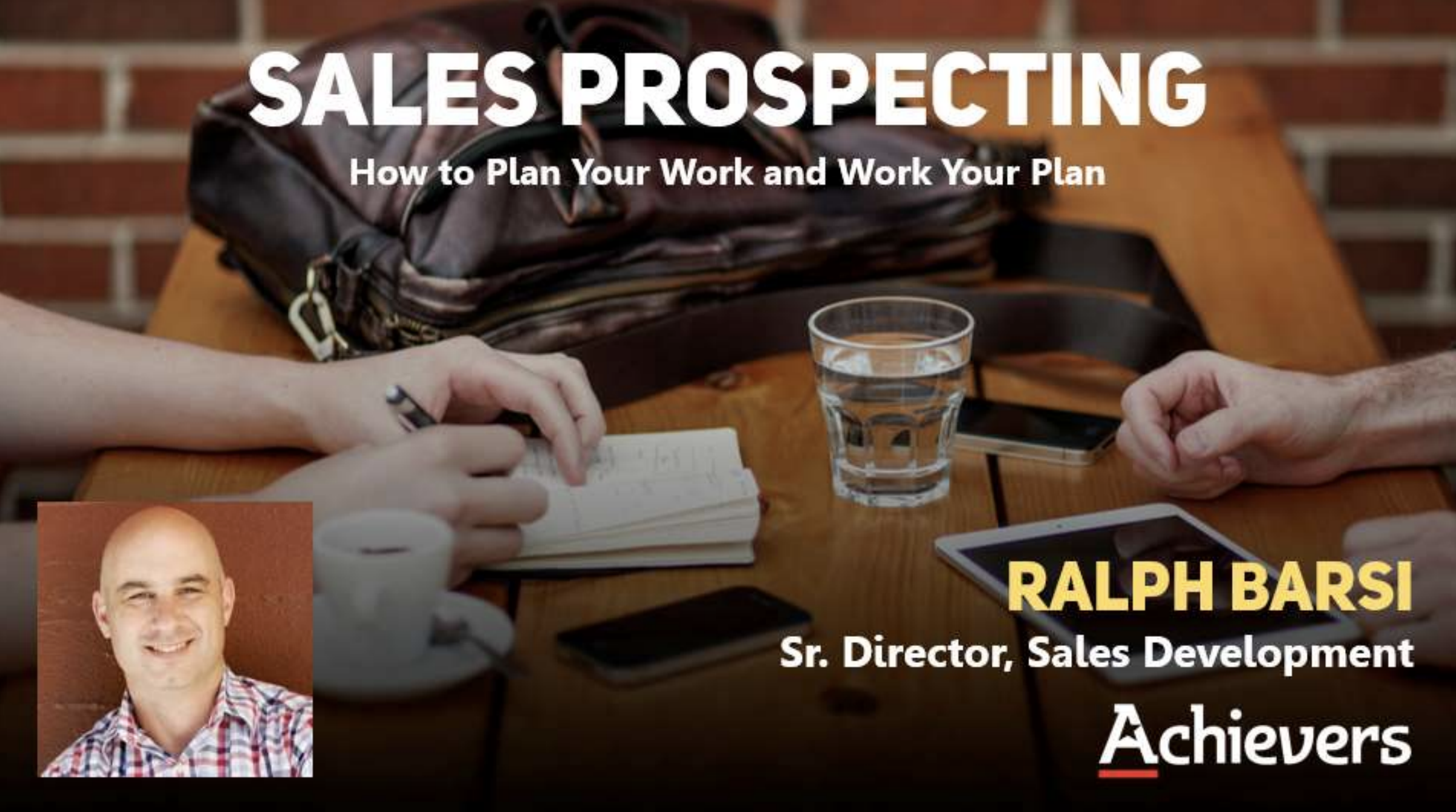
"Sales Prospecting: How to Plan Your Work and Work Your Plan"
Ralph Barsi
October 23, 2014
Summary
In this webinar for the Data.com community, Ralph Barsi (Senior Director of Sales Development at Achievers) presents a comprehensive guide to sales prospecting, focusing on how to "work the plan" rather than just "plan the work."
Ralph oversees a hybrid SDR team that handles both inbound lead qualification and outbound prospecting, developing reps into quota-carrying account executives over a two-year period.
The presentation covers seven key areas: planning the work, understanding the risks of not working the plan, recognizing that prospecting is more science than art, building personal brand and marketplace presence, knowing your ideal buyer and buying process with extreme specificity, implementing sales playbooks as living documents, and leveraging modern sales tools effectively.
Ralph emphasizes that success in prospecting requires treating emails like tweets (140 characters or less), leading with the prospect's world rather than your offering, using sales intelligence tools to arm yourself with relevant information, and becoming known in your marketplace through content creation and social selling.
A central theme is the transition from pursuing opportunities to attracting them through consistent value delivery and personal brand building.
Ralph shares specific tactics including the bookends approach to planning (Monday/Friday for prep, Tuesday-Thursday for execution), using shortened links to track engagement, bringing customers into prospect calls, and building lists that incorporate sales intelligence rather than just names and numbers.
The presentation concludes with practical tool recommendations and a Q&A session addressing email subject lines, LinkedIn premium value, list building, and what NOT to do (avoiding egocentric pitches and paragraph-long emails).
BIG Takeaways
Take Action-Oriented Notes Using the Two-Column Method
Draw a line down the middle of your notebook. On the left side, write all notes from presentations and meetings. On the right side, put all action items. This simple system prevents notebooks from gathering dust and ensures you actually implement what you learn.
Ralph spent the first 10 years of his career taking extensive notes that led to zero action, accumulating stacks of unused notebooks. The action column transforms note-taking from passive information gathering into active career development, creating visible progress and growth.
Prospecting Is More Science Than Art - Use the Fishing Analogy
You can't just pick a fishing boat out on the lake and expect fish to jump in. You need to:
(1) Know your fishing spot - break territory into major metro areas ("NFL cities"), identify prominent industries and verticals, then hone in on ideal customer profiles in those areas; (2) Know when to fish - most B2B buyers purchase in Q1/Q2, most execs talk Tuesday/Thursday between 10am-4pm (InsightSquared study), events like Dreamforce in Q4 generate leads that close in Q1/Q2; (3) Know why to fish - find trigger events through sales intelligence tools that give you real-time information, allowing you to approach the right person at the right time with the right message.
Get Known in the Marketplace to Shift From Pursuit to Attraction
Stop pursuing opportunities and start attracting them by building your presence. When prospects Google you (which they will after getting your email or voicemail), your LinkedIn profile will be the first search result - make sure it's a great storefront.
Build your brand through: writing articles and blog posts, producing videos, participating in industry association groups (SHRM for HR, AAISP for inside sales), answering questions in LinkedIn groups, hosting events locally/nationally/globally, and consistently sharing valuable content. The more value you add to the marketplace, the more valuable you become. Your emails get responded to when people have met you or recognize your name from the value you've been providing.
Know Your Ideal Buyer and Buying Process With Extreme Specificity
Get incredibly specific about who your ideal buyer is and understand their buying process deeply. Use the TOPO principle (specificity wins).
Your prospects don't know what they don't know, so educate them on the timeline based on similar businesses you've worked with. Show them what's needed from them, who they need to involve internally, and how to carry the ball across the line. See them as partners in shaping the process, and when you do this, you'll expedite everything. Things happen faster when you collaboratively design the buying journey rather than imposing your selling process on them.
Implement Living, Breathing Sales Playbooks Mapped to Your CRM
Playbooks are frameworks for working the plan and can be created for any part of the sales process (qualifying, prospecting, negotiating, closing). Gather disparate information into one centralized place: scripts, email templates, marketing collateral, leave-behinds, video testimonials.
Map the playbook to your CRM environment where salespeople already live. Use checklists at the end of each chapter to ensure fundamentals aren't missed. Aberdeen Group study proves year-over-year growth in ACV and quota attainment for teams using playbooks. The playbook reminds seasoned reps of fundamentals (like the bounce pass in basketball) and reinforces struggling reps who let things slip through cracks. Better to lose in round one than round 15 because you missed critical steps early.
Treat Emails Like Tweets - Short, Concise, With Question Marks
Keep emails to five sentences maximum, no paragraphs. Think in terms of 140 characters or less, forcing you to be smart about wordsmithing. Use shortened links (Bitly) for aesthetic appeal and tracking engagement.
Every email should have a question mark to evoke response. Use PS sections with links to relevant articles: "PS: Saw you thought this was interesting when you mentioned it in this article [link]." Sell the meeting and the time, not your offering in the email. Show numbers and ROI from existing customers. What NOT to do: Send paragraph-long emails with huge unshortened links, or start calls by talking about your company history, funding, and client list before understanding the prospect's world.
Leverage Relationships and Bring Customers Into Prospect Calls
Consider who your senior leaders are connected to in prospective accounts using LinkedIn (relationships matter). When approaching them, ask: "How do you want to proceed? You know 30 people in my target account. Would you like to email them all, call them, or should I frame up an email you can forward?"
This creates warm calls, not cold calls. Even more powerful: bring a customer into your meetings. Sales reps show slide decks with logo lists but rarely bring actual customers into conversations. When your customer talks about how they solved real-life problems (that your prospect is likely experiencing) using your offering, it's exponentially more powerful than you talking about yourself. Build solid relationships with customers specifically for this purpose.
Transcript
Moderator (00:04):
At the end of the presentation, feel free to type them in the questions panel on your GoToWebinar control panel. And we'll be answering some of those at the end. So I wanted to thank Ralph today for hosting this call. So Ralph Barsi is an inspiring leader with over 20 years of experience in sales. As the senior director of sales development at Achievers, Ralph is responsible for developing sales teams to produce results. Ralph is also one of our speakers at Connecton. So if some of you made it out there, you'll recognize him. So I'll just hand it over to Ralph now.
Ralph Barsi (00:42):
Thanks, Diana. Hello everybody. Hope everybody's having a good morning or afternoon, wherever you are in the world. I love hanging out with the data.com team and I really appreciate the opportunity to present to all of you today. So we'll spend the next 30 to 40 minutes tops going through some key areas that I think are really important when it comes to sales prospecting. Obviously we all know how to plan our work, but not everybody knows how to work their plan. So that's what I'm hoping to leave you with today is a couple of good, valuable nuggets on how to work the plan. And hopefully that'll get you off and running. And I've tried to include some stuff that you could actually take away and start using immediately. So one of the first things I want you to do is not trust your memory and take really good notes today.
(01:30):
And you should probably do this anyway. But one thing that really helps me is I'll look at my notebook or piece of paper I'm taking notes on and I will draw a line right down the middle. On the left side, I'll write all my notes that I'm getting from a presentation or from a meeting. And on the right, I put all my action items. And it occurred to me maybe 10 years ago now that, hey, you got to act on a lot of the notes that you're taking. What happened is I was taking a bunch of notes. I have stacks of notebooks to this day that are stacked up in my house. And for the first 10 years of my career, all I was doing was gathering dust on those notebooks. I wasn't taking any action whatsoever on a lot of the notes I was taking.
(02:13):
So put that action column in there, put things to use and you're going to find, you're going to see some progress in your career, you're going to see some growth and that's just nothing but good stuff. So that's your first tip for the day. Moving right along, there are seven key areas that I want to address while I'm with you. Obviously planning the work, the risk of not working the plan is an area I think is largely overlooked. So I do want to spend some time on that. I do think prospecting is more science than art. It's really important that sales leaders and sales reps get known in the marketplace. It's important to obviously know your ideal buyer and buying process. And I'm going to hang on this one a little bit when I get to that slide. What's really critical about this area is you need to get really specific with who your ideal buyer is and the buying process.
(03:09):
So we'll talk about that. One of my favorite topics of all time is using a playbook, both writing a sales playbook as well as implementing it in an organization. It's an ever evolving living, breathing document that's got to be worked on a regular basis. Or it too will gather dust just like my notebooks have in my house. And then finally, I've got a snapshot of some tools that I'm using every single day. They're all making my life easy and I think they'll make yours easy as well. You'll find that I'm going to focus a lot on sales today, as well as sales development. That's the function that I oversee. And that said, a lot of what I'm saying today is really cross-functional. It's really agnostic when it comes to how you can apply some of this stuff to your business and your everyday life.
(04:00):
So a little bit about me. I am broadcasting from beautiful San Francisco, California. It is the home of the greatest baseball team of all time, the San Francisco Giants. Despite last night's game in Kansas City, I think we're early in the series, so I'm not too worried about it. Achievers has an office in Toronto. We have an office here in San Francisco and we have an office in London. If you want to learn more about Achievers, just visit achievers.com. Essentially, we work with enterprise size accounts to bolster employee success throughout the organization. And how we do that is we have a SaaS platform that helps these companies bolster employee engagement, bolster employee alignment, be it with corporate initiatives or value statements. And then finally, we help companies bolster recognition of their employees. There's a staggering statistic that came out from Jobvite, I want to say 18 months ago, and it says that 69% of employed Americans are actively looking for another job or they're open to it.
(05:07):
So anyone on the line that might be in the recruiting industry, that's a fabulous statistic. But anybody in a position like mine where you're overseeing a sales team, that's pretty frightening. And it's a big flag for me to start focusing a little bit more on the hard work and the efforts that my team is putting in on a daily basis to drive revenue pipeline for our organization. And I've got to start recognizing my employees better so that they get a sense of, "Hey, I'm serving the greater good here. I know what piece of the puzzle I am in the organization and everybody wins when you're recognizing." So that's why I want to call those three areas out. With respect to my team, I oversee the sales development team. We call them the SDRs here and they're early in their sales career. Most of them are aspiring to become quota carrying territory managing account executives.
(06:03):
So we have them on the SDR team for roughly two years. You'll notice a lot of organizations, and your organization may do this, they'll split the teams up and they will have an inbound only team, which is responsible for lead follow up, lead qualification, working with the marketing and demand generation organization to make sure that leads are followed up accordingly. Meetings are scheduled from the follow-up of those leads and then ultimately viable opportunities are created for the pipeline. On the outbound side, it's the same outcome they're going after, but it's a little more complex and complicated in that they don't have that privilege or that luxury anymore of the inbound inquiry where someone's knocking on their door or raising their hand saying, "Hey, I like the offering or I like your company. I want to learn more." Instead, it's more of a proactive approach in a given territory where you're knocking on their door, hopefully at the right time with the right message and you're talking to the right people.
(07:10):
But in order to have all those come together, it takes a lot of research. It takes a lot of measuring twice and cutting once on the outbound side. So my team here at Achievers covers both roles in one. So it's a hybrid role, but we all know that there's a very finite amount of time that we all have to teach and coach and mentor them so that they become fighter pilots as account executives in just two years. So that's really what my focus is here at Achievers. I included on the slide at the bottom how my team continues to win because these are really important areas that sales development leaders and sales leaders in general should be focusing on on a regular basis with their teams. So my SDRs will help their account executives prepare QBRs. In fact, we're going through them right now at the start of our quarter.
(08:03):
They're also partnering with marketing on events. They're providing feedback for marketing on a regular basis. They're teaming up with customer success to make sure that we've got cross-sell and upsell opportunities that are being covered. And very important is we're studying competitors out there. It's a big reason why this partnership with data.com is so important is because you can target competitive accounts and you can be smart about the competitive account and their company so that you're up to speed so that when that person comes asking for information from you, you're armed and ready to go. So I couldn't emphasize enough how important that is. The very top bullet point is really the one I wanted to hone in on today, which is that continuous education. We're studying continuously. And in my world, it's five critical areas that I call the five levers.
(08:56):
And what I mean by that is we're talking about prospecting continuously, right? What works today in prospecting, whether it's an email template, a phone script, a voicemail, a webinar, whatever it is, may not work next quarter. It may not work in six months. So you've got to be up to speed constantly on what works in prospecting. And I use the word qualify, what's the qualification methodology you're using in your organization, if at all? I highly recommend you do. There are a number out there like BANT, which stands for budget, authority, need and timing. You want your people to be continuously getting better at it. The third lever is presenting. I mean, if you see an account executive who's a seasoned AE and they do discovery calls and demos all day, every day and all week long and they're not watching their video to critique themselves, how are they getting better?
(09:46):
If you're presenting all the time and you're not constantly studying what's working, what's not working, how can you improve your approach? You're going to lose out eventually because your industry's changing and the people you're presenting to are changing. And you've got to get more sophisticated. And the only way you're going to get more sophisticated is by continuously watching yourself and watching your peers and studying different ways that people are presenting. Fourth one is negotiating. Super fun. I mean, there's just books on this all over the place. You want to read one a month and you want to study continuously. And then finally closing, especially in my world with the SDRs, I want to make sure that they're closing the meeting properly. They're booking the meeting, they're getting it on the calendar. It's a completed meeting. And if it's converted to a viable opportunity, I want the SDR to be attending that meeting that the account executive is running so that the SDR is studying the sales process.
(10:37):
They want to be an AE. So they're getting hands-on experience by attending those meetings. That's just my philosophy. I know everybody does it differently, but I want to make sure that these people that are aspiring to have my job or a job like mine, they're continuously improving across all five of those levers. Okay. Seven key areas. The first is plan the work. The second is risk not working the plan. Third, it's more science than art. I'll repeat that one, prospecting. Fourth, get known. Fifth, know your buyer. Sixth, use a playbook. And seventh, use tools that make life easy. The first area, obviously plan the work. So how can you go wrong if you've got a plan in place? You need good clarity of your ideal buyer. You need to get behind a formal prospecting system. This is where playbooks come in handy. You've got to establish performance metrics and you need a weekly plan.
(11:35):
So examples would be you can't start a week Monday morning at say 9:00 AM and not have a plan of attack. You need to do it the week before or Sunday night if you're religiously putting in seven days a week. But I recommend that on a Friday afternoon, you tee up Monday. You know what you're going to hit when you arrive Monday. And an example of this would be you make a list of your top 15 to 20 prospect accounts that you're pursuing, and then you list the people that you're trying to reach within each of those accounts. You outline what your strategy is and you literally timeline what it's going to look like. So Monday morning I'm going to leave a voicemail. Monday afternoon I'm going to send an email. Tuesday morning I'm going to reach out to a relationship to see if they can get me in contact with this person.
(12:26):
And you do this across all 15 to 20 of those accounts and guess what? Executing is going to be a lot smoother. So you've got to have a plan and you've got to have a weekly plan like that. And as far as a playbook goes, of course we'll touch on that later in the presentation. To this day at Achievers, we're actually in the process of building out an official playbook. I've put together my sales development playbook. That's pretty comprehensive and it's got real good collateral and things in there to help those on my team. But I could argue that we should have a playbook for the entire selling process. It just makes it a lot easier for everybody. So I'll get into the nuts and bolts of that in just a few more slides. Second thing. The risk of not working the plan. You'll be working with inaccurate information if you don't work the plan and you don't have a plan.
(13:19):
So you wouldn't know if you're prospecting effectively and you will have no roadmap to fall back on, let alone a weekly plan. You're going to be spending a tremendous amount of time in the CRM system when you could be out engaging buyers. So think about all of those areas, they all tie back to not having a plan or they could be fixed by implementing some of these things that I'm talking about today. Most importantly, you won't be able to meet business objectives. You won't be able to hit quota. And if you hit quota, it'll be by sheer luck. And you know what, you can't bank on luck. I mean, at the end of the day, we all have a quota that we have to hit. And it's just not going to happen just by being lucky. You've got to work for it. And that's essentially what I'm talking about today.
(14:08):
Prospecting is more science than art. And the last thing I want to share on that is it does take art, but it's just not the majority of the pie. And the science part to it has to do with good data, good structure, and I'm talking about great, clean, validated data and you need a structure. And a structure is a playbook. There are specific things that are going to occur in a process and you need to map those things and you need to follow those things and you need to adjust along the way. But if you do your best to execute in a structured way, prospecting is going to be a lot easier and you're going to be a lot more successful. Obviously there's going to be art to every conversation you have, but the structure of it doesn't change. And that's where you can take the good guesswork out and really hone in on being really specific on all the key areas that contribute to effective prospecting.
(15:02):
There's really three buckets to successful prospecting. I call them the PPPs, the three Ps. And of course, I've always loved alliteration. You've got process, you've got people, and you've got platforms, right? You need good solid processes. Think methodology here like TOPO. Is there a TOPO out there? TOPO is an organization that does terrific work on helping sales teams and sales development teams with their processes and very specifically around prospecting. People-wise, it's all about self-development, right? Are you investing enough time to upgrade your knowledge and proficiency in all the areas where you could get better? And tools, whether you got the technology in place or not, and it's the combination of all three of these Ps that are going to contribute to successful prospecting.
(15:57):
Get known in the marketplace. This is very important. One of the five barriers I talk about when I share with sales reps or when I'm speaking on stage is obscurity. When people do not know who you are in the marketplace, your job is that much harder. So you've got to get known and there's a number of ways to do that. I've listed a lot of those here on the slide. Joining industry associations is huge. I mentioned American Association of Inside Sales Professionals. If you're in marketing, obviously there's a ton of marketing associations you could be a part of. If you're in inside sales or sales development specifically, join AAISP. Join InsideSales.com and get plugged into all those communities. If you're in HR, just a few months ago I joined SHRM, which is the Society for Human Resource Management. It's the largest human resources association.
(16:52):
I've got a webinar that I'm doing with them later this month and they invited me to be one of their members. So I had to join and I did. And I'm learning a tremendous amount from an HR angle on what our marketplace is dealing with. It's very enlightening and it's causing me to get smarter about who our buyer is and what their challenges are. I would highly recommend that as well. How about networking? It's really important to continue to network in your industry, but more importantly to network in your prospect's industry or your buyer's industry. Join groups on LinkedIn that are relative to who your buyer is so that you can start answering questions to help out people with similar questions and provide really good value to them. And in turn, you're building these relationships with people that you may eventually engage at some future point in time.
(17:42):
Obviously, blogging and publishing. If you're not a blogger and you're not a writer, that's completely fine. There are so many people out there and so many companies out there that are sharing awesome content. Just hit share or retweet or something along those lines and share their content. That's a surefire way of getting to know those people, getting on their radar, and getting known as well. It's all about bringing value to the marketplace. So if you bring value to the marketplace, you're automatically going to get exposure and you're going to be seen by more people. Creating and speaking, if you can, if you've got the capacity, come up with something that you could present to an audience be it an organization, an association, or just an internal meeting, for example, at your own company. Bring value in that presentation. Share with people and tell a story and that'll help you get more known.
(18:37):
Partnering with customers and bringing them in as assets is huge. So for example, if you've got a customer who's not only a really good happy customer, they're willing to help you out. Invite them to a webinar. Invite them to a panel. Invite them to a roundtable. Invite them to meetings with other prospects and get known through that partnership that you've built with your customers. And then obviously using social media. You definitely want to use your social media presence to share value that you're bringing to the marketplace. Share the stories that are happening in your industry and in your marketplace. And you'll be surprised how many people will start following you and start engaging with you. And it's really awesome when they start to recognize you in emails and things like that. It's pretty cool.
(19:29):
So there's a lot of good articles and case studies and books out there. The first is called the Epic List and it's from my friend Coco Sexton over at LinkedIn. And he curated a number of different articles, Slideshare presentations, et cetera, on how to bolster your LinkedIn profile and really what areas you need to focus on to attract the audience that you want to attract. I highly recommend that. That's followed by a great piece by Jill Konrath on her blog where she features Joanne Black and Joanne is an expert in referral based selling and wrote a really killer book that just came out this year. It's called Pick Up the Damn Phone. And this is a great article on Jill's blog that highlights some of the stuff that Joanne is constantly sharing with the marketplace, especially sales reps. So I highly recommend that. Obviously when someone Googles you, and that's likely what they're going to do if they have any interest whatsoever in an email that you just sent them or in a great voicemail you just left them, they're going to Google you.
(20:20):
And in large part, the first search result that's going to surface is going to be your LinkedIn profile. So you got to make sure it's on point and that's buttoned up, but there's also a lot of other areas that will help weight the search results in Google so that the right stuff that you want appearing in the search results under your name are going to appear. So check that out. It's a great article on Mashable. A couple others here, I'll fly through, get better at networking, awesome article on Inc. and there's also a great book by Keith Ferrazzi called Never Eat Alone, and it's just telling you how to approach an industry event, for example. What's really important for salespeople to know, especially if you're getting into a new industry, you've got to get involved in the associations and the relevant groups.
(21:08):
There's a ton of groups on LinkedIn that you could join, but what's really important is when you participate in those groups, you start answering questions from some of the other members or you start posing thought provoking questions of your own and in time you start to meet the people that are responding to you and vice versa. Also, if you are in HR, for example, like Achievers is, you want to be part of SHRM. That's the largest human resources association. If you are in inside sales like I am, you're going to want to be involved in the American Association of Inside Sales Professionals, which is AAISP. Get involved in local chapters, you get the point. Lastly, get better at using social media. Gary Vaynerchuk is a master of social media. You're going to want to check out his book, Jab, Jab, Jab, Right Hook, so that you know how to leverage the different social media channels that are out there to get to the goals that you're trying to accomplish, not necessarily to become great at social media.
(22:09):
You want to attract new business by hosting events, whether they be locally, nationally, globally. There's so much value in obviously meeting people face to face. Your emails I guarantee are going to get responded to if you've met the person before and have actually engaged them in a really good conversation. And then some tips and tricks on how to become an expert and how to really add value to your industry. And like I said, over time you become more valuable in the process. Okay. One of my favorite concepts about prospecting is you can't pick a fishing boat out on the lake and just expect the fish to jump in the boat. There's specific things you need to do when you're prospecting in a given territory. You got to know your fishing spot. You got to know the territory that you've got, break that territory up into the major metropolitan areas.
(23:01):
I call them the NFL cities and you got to take a look at what industries and verticals are prominent in that given territory, and then just keep honing in on what your ideal customers look like in those given verticals and in those given territories. You got to know when to fish, what time of day to do it. There are a number of studies out there that support most B2Bs buy in Q1 and Q2. It's a big reason why events like Dreamforce are held in the fourth quarter of a calendar year, because a lot of those leads will come to fruition and turn into viable opportunities that will close in Q1 and Q2. So it makes sense. Most execs talk on Tuesday and Thursday. You're going to want to call between 10:00 AM and 4:00 PM, and that's actually a brand new statistic done by a study from InsightSquared.
(23:50):
And you'll definitely want to look that up online to get more information, but I've also included it here on the bottom of the slide. You can see where the sources are and you can access it through those links as well. Why do you want to fish? Well, you got to find trigger events that are relevant so you can approach the right person at the right time with the right message. Perfect way to do that is through sales intelligence tools like data.com, embedded right there in your CRM system. You've got real time, in the moment, intelligence and information on the companies you're pursuing, as well as the people you're pursuing. Instead of you having 10 browser windows open on your laptop, looking up information on a given person or a given company, you've got sales intelligence tools out there that can push this information to you.
(24:40):
They aggregate it from tens of thousands of sources, they use crowdsourcing, there are a number of resources they're pulling from. They're triangulating this information, they're validating the information, and they're pushing it to you so you know what you're talking about when you finally engage those key prospects and those influencers. Consider knowing who your senior leaders are connected to in your prospective accounts. LinkedIn, their motto is relationships matter, no joke. Relationships really, really matter. So one of the first things you're going to want to do in your given territory is find out, okay, who do I know in this territory or who do I know that knows someone in this territory? And it's really important specifically when you're approaching a senior leader in your organization that might be connected to a prospective account. It's really important to ask them, "How do you want to proceed? It looks like you know 30 people in my target account.
(25:38):
Would you like to send an email to all of them? Would you like to call all of them? Or would it work best if I frame up an email that you can go ahead and forward to them?" Either way, you have to flesh out what's the best approach for them, and I guarantee you're going to get a lot warmer calls out of the process. You won't be calling cold at all when you're leveraging the relationships that already exist in these accounts. Consider bringing a customer on your call. I can't tell you how many sales reps show slide decks in their presentations of all the logos that the company works with, yet none of them are bringing customers from those logos into their meetings. And trust me, there are a ton of customers out there that would be pleased to do something like that and share their experience.
(26:29):
So if you've got solid enough relationships with your customers, this is a surefire way to get your prospect's attention is when you've got your customer talking about you instead of you talking about you, because they're talking about real life problems that your prospective account is likely living through and how those problems were solved by your offering. So that's a big, big takeaway that you should take note of. And then finally, on the far right, know how to use bait. Don't send emails that are paragraphs long. Don't send emails that have huge links. Make sure that you're using shortened links, that you're sending concise messages that are no more than five sentences long. All of your emails should have a question mark in them because that evokes a response and that's what you want at the end of the day. You want to sell the time and you want to sell the meeting versus selling your offering right there in the email.
(27:23):
So definitely something to consider. And then lastly, show them numbers. Show them the return on investment that your customers are seeing today, where they were, and now what's happened as a result of you being there.
(27:40):
I really want to talk about playbooks. It's one of my favorite topics in sales. Just like methodologies, they're a perfect example of how to work a plan. It's a framework. You can write a playbook or use a playbook on any part of the sales process. Some companies will use playbooks specifically for qualifying or specifically for prospecting or negotiating or closing. You choose what's best in your world and in your organization and immediately start framing up a playbook. All the reasons on the left are why you should have a playbook. You're gathering all this disparate information into one place, whether it be scripts or email templates or marketing collateral or leave behinds or video testimonials. You're bringing it all in one place in a playbook. If you're going to use videos, for example, you want to consider using an ebook. You also want to consider mapping that playbook to your CRM environment so that everybody is on the same page, so that sales reps continue to live within the CRM where most salespeople live anyway.
(28:52):
It's just easy for everybody and it makes life a lot simpler. You'll notice I love lists. I think every slide I've shown you today has been a list. What I love about lists is I like the act of actually checking off or crossing out stuff that I'm getting done because it shows progress, it shows growth. And it's just an exciting way to get through the day is when you're just checking stuff off, you know you're knocking stuff out. A key thing that I want to point out on that left column about why you use a playbook is it reminds seasoned reps of fundamental stuff. It also helps reinforce struggling reps that might be letting things slip through the cracks or just missing the fundamentals. It's like the bounce pass in basketball. It's a pass that you will always use while you play basketball and it always helps you get the job done.
(29:44):
So an example in terms of sales would be, it's better to lose in the first round of a deal than the 15th round, right? So you don't want to get to round 12, 13, 14, and the deal completely folds because of critical stuff you missed in round one and two. So what you want to do in your playbooks is at the end of every chapter, for example, you'll want to have a checklist and you'll be able to check off the boxes whether or not you were able to knock out all the areas suggested in that chapter. And later in the process, it's a great reference guide for you to go back and say, "Hey, did I do this? Did I do that? Did I get in touch with so-and-so?" And it will help you throughout the whole process. The last bullet point came from an awesome study from the Aberdeen Group.
(30:32):
I included a link in the source part of the slide there. I highly recommend you check out this report. It proves year over year growth in multiple areas. And those areas include ACV, sales team attainment of quota versus individual attainment of quota, both see lift in year over year growth based on having a playbook and implementing a plan and really working that plan. So highly recommend you downloading that Aberdeen Group study. Obviously you want to choose your stakeholders, who's going to write it, who from the senior leadership team is going to support it. You're going to need a quarterback to write the playbook. And if you're in the midst of writing one right now in your organization, or if you have one and it's just not working out as you thought it would, or if you're just thinking about using a playbook for the first time in your organization, there's a tremendous amount of great resources out there.
(31:32):
I've not listed them in this presentation, but I've got my contact info all over this deck. Don't hesitate to reach out to me and I'll put you in direct touch with people that could really help you get it done and get it done the right way, the first time. So take me up on it. Okay? Lastly, you got to use tools that make life easy and you notice the footnote at the very bottom of this slide. This is just a handful of stuff that's going to help you out. Most of you are probably using this stuff. You could use SalesLoft, you could use InsideView, you could use data.com, you could use LinkedIn Sales Navigator. Not all of them exist to replace each other. They all complement each other. And if you're using them the right way, it's going to make life so nice when it's time to prospect into really big accounts, for example.
(32:22):
I mentioned using shortened links in your emails. Bitly is probably the best out there. Not only are you aesthetically pleasing your prospect with a nice, concise, brief email, but the shortened link can be tracked. So you know whether or not they're opening the links that you're sending and if they're really engaging with you. And where these links really help in emails is in a postscript. So you'd say regards, Ralph, PS, saw that you thought this was interesting when you mentioned it in this article. And you hyperlink the article or you just put a little Bitly link to the article and you could track whether or not they checked it out. There's a lot of great social media platforms out there. Klout, as I mentioned earlier, Buffer, Hootsuite, Post Beyond. Those are great platforms for you to listen to what's going on in the marketplace, as well as share valuable nuggets with the marketplace.
(33:17):
So I encourage you to check those out. For the traveling sales reps out there, God bless you. I know it's not as glamorous as it sounds. I've been a road warrior myself. There's nothing like TripIt, especially when we spend most of our time on mobile devices. TripIt is an awesome application that gathers all the itineraries that you have coming down the pike with respect to your trips. It just sets some order in your life and causes less confusion. And then I'll hang on one last app I want to point out, which is IFTTT, If This Then That. Those of you not using it, just go check it out today. Take a look at the homepage, get used to what they call recipes and get acquainted with them. And I guarantee you you're going to find one that's going to help make your life easier. For example, if you're trying to build your follower base on Twitter or you get invites on LinkedIn and you just don't have the time or the bandwidth to respond to them, but you want to.
(34:11):
If This Then That will help you set up some automatic responses that are in your voice, that'll at least touch that new follower and let them know that you're thinking about them, that you appreciate them following you. And it's really important if you're trying to become an expert in the marketplace or you're just trying to get more exposure. So I hope at least one of those links helps you out. Again, I do want to continue the conversation. If there's any questions from today's presentation, I think we've got a little time that you're welcome to ask now, or you could just reach me offline in any of these locations and we'll continue the conversation there. But all in all, I really appreciate being here. I appreciate everybody's attention and carving time out of your busy lives to hang out with data.com and me.
Moderator (34:57):
Excellent. Again, as a reminder, we will be sending out the slides and a recording from today's presentation to everyone who's attended on the call and everyone who's registered. So feel free to forward those on to your colleagues and you can expect those in the next couple of days. If you do have questions, feel free to type them again into the GoToWebinar control panel and we'll be sure to answer some of these. We have a couple questions here, Ralph. One from Lindy, do you find that the upgraded premium versions of LinkedIn are beneficial for sales?
Ralph Barsi (35:30):
Oh, good question. Thank you, Lindy. I do. We use Sales Navigator and it's premium here at Achievers and we've already found great benefit from it. It might take some time for you to get acquainted with it and learn how to navigate through it, but they've got some really good new tabs that are going to help you really keep track of who you're talking to or who you want to talk to. They also have really good list building capabilities that I've seen bring a lot of benefit to my team. And I'll point out, one of the experts in the field who does not work for LinkedIn is a gentleman named Jamie Shanks. And Jamie's out of Toronto. He works for a firm called Sales for Life, which is his firm. And he and Sales for Life have created an awesome application that tags onto Sales Navigator and some of the premium versions of LinkedIn that really help salespeople specifically target accounts, get the information, the intelligence they're looking for, and really wrap their arms around a territory.
(36:32):
So great question.
Moderator (36:35):
We have another question here. You mentioned for emails to keep them kind of short and concise, clean and concise. What would you say is a good subject line for an email or maybe a formula for a good subject line?
Ralph Barsi (36:50):
Love it. So a great presentation was published probably a year ago from someone in the marketing team or the community management team over at Salesforce and it's 100 Best Email Subject Lines. It applies to both B2C and B2B. If you go to my page on Slideshare, it's Ralph Barsi or RBARSI. There's a presentation that I did and it is, I want to say it's the Five Barriers That Block Reps From Hitting Their Quota. And in that presentation, it's towards the final third of the presentation. I actually have a link and the cover slide of that 100 Best Email Subject Lines. Download that, check it out. And if you're not finding good subject lines from that presentation, which I highly doubt, hit me up and let me know. And I've got a couple other really cool resources for you to check out.
(37:48):
Cool.
Moderator (37:49):
Another question here. What book or resources would you recommend for new sales development reps?
Ralph Barsi (37:56):
Sure. So it's Aaron Ross, and it's called Predictable Revenue. And it's essentially all the areas and tools that you're going to want to focus on if you're building out an inside sales organization or sales development organization, and it covers both the inbound side of things, as well as the outbound side of things. And Aaron gets really granular in that book and really goes through day-to-day tasks and activities that you need to be managing and monitoring to have a really well oiled machine on the sales development side. So again, it's Predictable Revenue by Aaron Ross. I want to say it was published five years ago, and it's a book I still reference to this day.
Moderator (38:23):
Again, what was the name of the company that has an app for LinkedIn Navigator? I'll type it in.
Ralph Barsi (38:30):
Oh, sure. It's Sales for Life and it's sales and I think the number four life. And again, the gentleman that helps run that operation is Jamie, J-A-M-I-E, Shanks, S-H-A-N-K-S. So if you just Google Jamie, he is all over Twitter. He's a social selling expert. So I have no doubt you'll be able to contact him directly. And if you're struggling getting to Jamie, send me an email or tweet me or connect with me on LinkedIn and I'll make sure to broker that introduction for you.
Moderator (39:07):
Great. One question. Again, I typed that in the chat box so that's available to everyone on the call. Do you think there's any way to build a list of warmer, hot leads for sales?
Ralph Barsi (39:22):
Absolutely. And here's what's important. Don't just build a list of names, titles, and phone numbers and emails that you hope are the right ones. What you need to incorporate in those lists are sales intelligence areas. So for example, data.com, they'll give you information on what's happening with the specific people you're trying to reach in the news. Did they just sit on a panel? Did they just host a webinar like this one? What's going on with the company in the news? When you've got that kind of information, in addition to the name, title, email, phone number, now you're cooking with gas and you can actually reach out to those people with some relevance. Otherwise, you're just cold calling. When I was a sales rep way back doing nothing but cold calling, we had the old printout green bar sheets that I would literally go down with a ruler and a pen.
(40:13):
I would make a phone call, I'd leave a crummy voicemail, I would hang up, I would draw a line through the name and I'd go down to the next one. Essentially, that's what you're doing today if you're just drafting up lists of names and numbers. You've got to have some intelligence around those and make the data work for you.
Moderator (40:32):
Okay, great. Do you recommend any all-in-one software solutions for internet marketing?
Ralph Barsi (40:41):
For internet marketing? I'm not sure I understand the question. Just for exposing your brand and your company?
Moderator (40:48):
Yeah. I'm guessing since you did mention a couple of sales tools, if you maybe had any sort of comprehensive suites or marketing tools that you may know of. If not, this person probably can reach out to you privately and maybe ask for some more details.
Ralph Barsi (41:07):
Yeah. If I am understanding the question, one tool that we use that I mentioned is called Post Beyond. It's one word. They're a Canadian organization and they provide us with a platform of content. So content that we're not necessarily generating but is relevant to our marketplace in human resources, for example. My sales development reps are able to leverage a platform like Post Beyond to regularly and consistently broadcast some really good content, share great articles, talk about speakers that are speaking in the HR world. And it really resonates, as you can imagine, with our industry and with our marketplace. And suddenly we're seen as experts in the field and our rapport is there, our credibility is there, and our reputations precede us so that when they do get an email or an inquiry from one of my reps, hopefully they're familiar with those reps already because the reps have been pumping out nothing but valuable content over the previous months or weeks.
(42:11):
So I hope I understand that question. If not, by all means, reach out to me and we'll make sure we get an answer to it.
Moderator (42:20):
I just sent over your email, so if he does have additional questions. Yeah, feel free again to reach out to Ralph if you do have questions after the call or any follow up questions. Again, we do have a little bit more time for some more questions, so please feel free to type them in the GoToWebinar control panel.
Ralph Barsi (42:36):
Cool. Yeah, the questions have been awesome so far. Thank you. You got me on my toes today.
Moderator (42:42):
We have a question here. Can you recommend maybe a good company or tool to kind of help with social media in terms of sales that you mentioned?
Ralph Barsi (42:52):
Yeah. Again, I would encourage you to look into Jamie's organization. No, he's not paying me to plug his organization, but Sales for Life is going to be one of the first stops in terms of how to best market your organization. They really know what they're doing. Also, you can reach out to Coco at LinkedIn. He is all over the internet, if you're not yet familiar with him and is very helpful. If he can't help you himself, he knows everybody in the industry and can plug you directly into the right organizations that are best for your company.
Moderator (43:28):
Great. Sorry, just filtering through some of these questions here.
Ralph Barsi (43:37):
No, no sweat. They're great questions.
Moderator (43:41):
Where do we find the Five Barriers That Stop Sales Reps From Hitting Their Quota presentation?
Ralph Barsi (43:45):
So you can just type that title into Google for starters. Five Barriers That Block Sales Reps is all you have to say and I'm sure it'll come up, but the best place to do it is to go to slideshare.com.
Moderator (44:03):
I'll post it in the chat. How about that?
Ralph Barsi (44:07):
Awesome. Yeah. I have pretty detailed info that addresses all five of the barriers. And again, these are just barriers that I've run into and I've seen happen to sales reps over and over again. And I hope I've provided some good tools to overcome the barriers. One thing I point out in that presentation is that all five barriers are self-imposed. So it's not like you can't get through them and be successful in your sales career. You just got to know they exist and know how to navigate around them.
Moderator (44:39):
Okay. Excellent. Lots of great ideas on what to do. Any advice or insight on what not to do?
Ralph Barsi (44:48):
Yeah. So a great example is in the outreach, like I said, short, concise emails, you have to treat an email, for example, like it's a text or a tweet. You have to think in terms of 140 characters or less. And I challenge you to try to do that. It means you have to be really smart about how you're crafting your message. You got to make sure you're wordsmithing things the right way. And that takes a lot of time to do, and it certainly takes a lot of time to get really good at it. So that's a good start. Also, what not to do is don't show up and start talking about you and talking about your offering. A lot of sales reps get happy ears when their prospect picks up the phone and they're actually there in the office and here's your shot. And what they do is they end up just talking about, "Oh my God, this is what Achievers does and we've been around X number of years and we're supported by Sequoia Capital and we're working with A, B, C, D." And you're not spending any time whatsoever on the client and on their world.
(45:51):
And as a result, you're going to have a really tough time in the process because you're so egocentric through the whole thing and talking about yourself. So do whatever you do, face outward and start focusing on everybody you're serving in the marketplace and in the industry. And in time, when it's the opportunity to present itself in an opportunity, you could start talking about your offering and the value you're bringing to other like companies or industries. So those are a couple words of advice right out the gate.
Moderator (46:23):
Great. Another comment here. I was calling prospects yesterday and the conversation was not very engaging. Any thoughts on how to improve that part of the process? And I think you covered it a little bit with your previous advice.
Ralph Barsi (46:36):
Yeah. I'll tell you right now, if you genuinely believe in your offering and you genuinely believe in your company and what it is you're doing for them, it's going to come out. It's going to be visible whether you're trying or not. So when you leave a voicemail, leave a quick voicemail that's enthusiastic and energetic. Oftentimes my sales reps will say something like this on a voicemail: "Diana, Ralph with Achievers, 510-435-1010. I have a quick question for you. Look, there's no need to even call me back. I'm going to send you an email that's got a little detail behind the purpose of the call. In any event, I'm sure we're going to cross paths soon and I can't wait to talk to you." Done. Takes 15, 20 seconds, no more than that. And it's very intriguing and compelling when you say, "There's no need to call me back." And you're not droning on and on about why you're calling and, "Yeah, we've been working with so and so and they've seen an increase in this and an increase in that."
(47:35):
No one cares guys. Just when you're enthusiastic and you're quick and you appear to be extremely busy, you're working and dealing with a lot of other people and companies, they will come to you because they know you're somebody that's going to get stuff done for them. And if, God help you, if you're doing well in terms of adding value to the marketplace and you're making your presence known, it's even better. So if you've got good writing skills, write an article, contribute to a blog, do something to get your name out there so that when they do learn about you, they're seeing nothing but goodness that you've been providing the marketplace. I guarantee they're going to talk to you.
Moderator (48:15):
Awesome. I have a question here, but I think I can answer this one. Can you suggest a place online to get good leads? So many of you joined this webinar because you're all members of data.com, but if you use the free version of Connect, which is connect.data.com, it's basically a database of contacts that sales, marketing, and recruiters can use and it's completely free. So that's one of the places to get good leads online. And again, if you have questions about it or if you want to learn more about it, just feel free to email me at diana.wong@salesforce.com.
Ralph Barsi (48:53):
I have nothing to add to that. That's exactly right. Take Diana up on that and learn more about Connect and yeah, you're going to get some viable leads and hopefully opportunities too out of that effort.
Moderator (49:08):
Excellent. Again, I think a couple of you may have missed this, but a recording and the slides will be sent out after the call. So you can expect those in the next couple of days. And if you can't find them, reach out to me or be sure to check your spam folder. Are there any other questions? Feel free to type them in the panel or reach out to Ralph at rbarsi@gmail.com. And I posted the links to his Slideshare as well as Sales for Life and Jamie Shanks' name and the product he uses. Also, I was going to post, someone had a question about the book that you mentioned. It was Jab, Jab, Jab, Right Hook, and you can get that on Amazon as well. So I'll send that link out too in the chat window.
Ralph Barsi (49:58):
Awesome. And you'll want to follow Gary Vaynerchuk on YouTube. He does an episode every other day. It's like 10 minutes long. He's answering these same questions specifically around social media presence and branding and he is the best out there right now. And I listen to Gary and watch Gary's show all the time, so highly recommend it.
Moderator (50:21):
Excellent. So it looks like there are no more questions. Feel free again to reach out to me if you want more information about Connect. Again, it's a free database. We do these webinars twice a month too, so just be sure to check your email for the next topic. We will have Ralph probably return for a couple more webinars if you like this stuff. So again, feel free to reach out to Ralph as well if you have questions.
Ralph Barsi (50:46):
Yeah, go get after it.
Moderator (50:49):
And thank you everybody for joining the call. And thank you Ralph.
Ralph Barsi (50:53):
My pleasure. Have a great day everybody.
Moderator (50:56):
Thanks. Bye.
Ralph Barsi (50:57):
Bye-bye.