🎙️Transcript: Building a High Performing Sales Development Culture
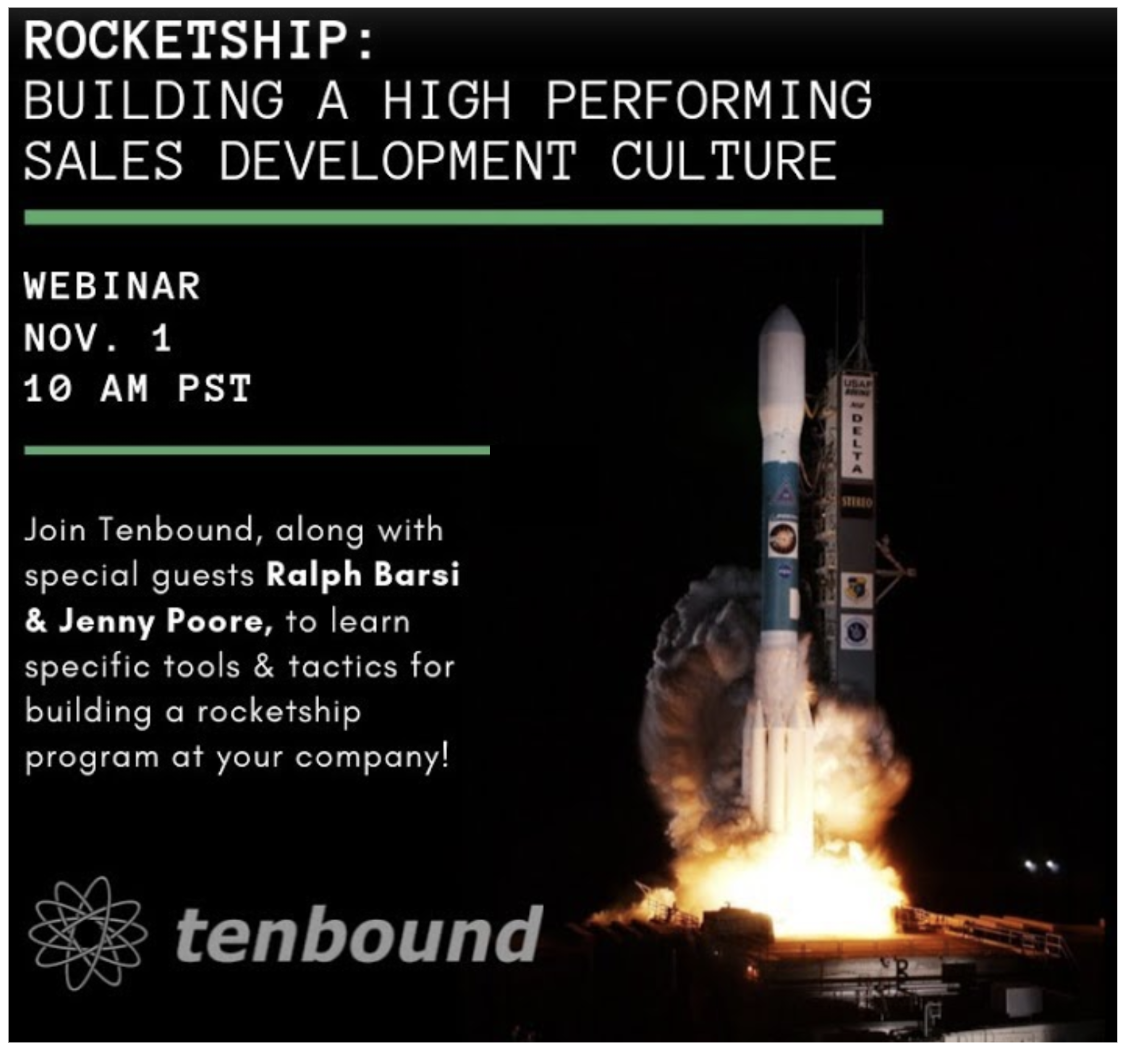
Tenbound - "Rocketship"
"Building a High Performing Sales Development Culture"
David Dulany, Jenny Poore, Ralph Barsi
November 1, 2019
Summary
This Tenbound webinar brings together two accomplished sales development leaders to demystify the often "soft and fuzzy" topic of culture building.
Jenny Poore from Sprout Social and Ralph Barsi from Tray.io share hard-won insights on creating cultures where SDRs wear their role as a badge of honor rather than viewing it as something to escape.
The conversation reveals that strong sales development cultures aren't accidents—they're deliberately designed systems where values are defined, expectations are clear, and every team member understands they're part of a temporary but transformative experience.
Both leaders emphasize that culture extends beyond feel-good platitudes; it manifests in tangible outcomes like SDRs who get promoted consistently outperforming external AE hires, creating an internal talent pipeline so strong that companies don't need to depend on external recruiting.
The discussion explores the delicate balance between top-down leadership and bottom-up team ownership of culture.
Ralph draws on Bill Walsh's coaching philosophy, viewing his SDRs as future alumni who will carry the team's standards into their next roles, while Jenny implements innovative practices like peer-nominated quarterly team leads and "manager readmes" that serve as user manuals for working with her.
Both leaders stress the finite nature of SDR tenure—Ralph memorably shares a life chart showing SDR time as a tiny blip on a 90-year lifespan—and how this temporal reality should inform both how leaders develop their people and how SDRs approach the role.
The message is clear: this is tough work, but it's also the foundation for an entire sales career, teaching skills like conversation flow, networking, and resilience that compound over time.
Tactically, the webinar provides concrete frameworks for building and maintaining culture, from Jenny's approach of documenting and iterating on manager values to Ralph's practice of weekly updates that cascade through the organization and get forwarded by SDRs to their supported AEs.
The panelists address the hard questions too—what to do when you inherit a toxic culture or when rapid company growth changes the culture fundamentally. Their advice centers on personal agency: be the change you want to see, lead by example, share your successes without ego, and always come to your leader with solutions alongside problems.
The underlying philosophy is that culture isn't something that happens to you—it's something you actively create through consistent daily choices about how you show up, how you treat others, and what standards you hold yourself and your teammates to.
BIG Takeaways
• Create a Badge of Honor Culture—Reputation Should Precede You – Jenny emphasizes that the ultimate test of SDR culture is whether team members proudly say "I'm on the SDR team" or "I'm cold prospecting into enterprise" like it's a badge of honor.
Ralph extends this by noting that people go where they're celebrated, not where they're tolerated, making employee engagement and recognition non-negotiable.
When SDRs carry themselves with high standards of integrity, respect, kindness, execution, and service on a consistent basis, it spills into the external ecosystem where other companies and teams learn about your culture's performance and want to join.
Internally, this means SDRs must be proud of the fuel they're putting in the rocketship—not 87 octane but ethanol—the highest quality contribution. Until the team collectively decides "we're going to be a team of A players, no one's going to mess with us," it will be an uphill climb.
The goal is creating a culture where promoted SDRs consistently outperform external AE hires, building such a strong internal talent pipeline that you don't depend on external recruiting.
• The Manager Readme—Give Your Team a User Manual – Jenny introduces a powerful onboarding tool: a "manager readme" document she gives every new hire on day one that outlines her internal values, work preferences, and communication style.
This user manual evolves—she's changed it 10 times—and in the last one-on-one before promoting someone, she asks "what in that readme doesn't apply anymore? What did I lie about or what has changed?"
This level of transparency helps team members understand the rationale behind their leader's actions without having to guess or mind-read. Ralph emphasizes this drives home the principle of "seek first to understand before you're understood"—if more leaders provided this context upfront, it would calm the waters considerably.
The readme isn't meant to be prescriptive about how you must work with the manager to avoid a bad relationship; rather, it's level-setting that acknowledges we're all humans with different personalities, and culture can simply mean making sure everybody really understands one another with values as guiding principles.
• View Your SDRs as Future Alumni—This Is Temporary by Design – Ralph shares a profound mindset shift drawn from Bill Walsh's coaching philosophy: everyone on your team today is there for a temporary, finite amount of time.
You must lead and develop them so they can move up and onward in their careers while illustrating the standards they learned on your team. See your team as future alumni who will represent your organization well in their next chapters.
Ralph reinforces this with a striking visual from Wait But Why—a life chart of someone living to age 90 where SDR tenure is a tiny highlighted blip, barely visible. This temporal reality should inform everything: SDRs need to know upfront this is arguably the toughest job in the company but also the most foundational, teaching skills like networking, conversation flow, and LinkedIn profile management that carry through an entire career.
Leaders should share this perspective with the entire company so everyone collaborates to help SDRs during this critical development phase. The message to SDRs: take a deep breath, be a student, wear a student's cap, put your ego at the door, and stop thinking about yourself—focus on teammates, prospects, and the AEs you're supporting.
• Write It Down and Make It Collaborative—Strategy, People, Process, Technology – Both panelists strongly advocate for documenting culture rather than relying on mental telepathy.
Ralph's framework zooms out to strategy, people, process, and technology, then zooms in on each category, moving from strategy to tactics. He reminds not just SDRs but all key stakeholders—marketing, demand, customer success, finance, field organization—that SDR teams drive a twofold objective: revenue pipeline for the business and talent/people pipeline for the business.
Jenny's approach involves writing things down in ways that can change and evolve, making the process collaborative especially with leadership teams. The weekly update practice Ralph employs cascades through the organization, with leaders tailoring interpretation for their audiences.
When SDRs forward these updates to the AEs they support, word spreads to leadership and other AEs, transforming the team from "just the sales development team" into a unified team with field and all stakeholders. Without documentation and deliberate communication, it devolves into the telephone game where things get lost in translation.
• Peer-Nominated Team Leads Create Ownership Without Fake Promotions – Jenny introduces an innovative cultural practice that avoids the common pitfall of unclear team lead positions.
Instead of putting someone into a team lead role without actually making them a manager (which she's not a proponent of), Sprout Social has peer-nominated team lead positions that rotate quarterly.
These leads run player-only meetings without their manager present, bringing the team closer together while bubbling up concerns and feedback that team members might not share openly otherwise.
This approach delegates leadership capacity while setting clear expectations: "You are in an elevated position and I expect a lot from you." The result is the entire team levels up and understands their responsibility includes taking on these duties rather than just asking for things from their manager and getting upset when they don't happen.
This tactical approach to culture building demonstrates that empowering team members with real responsibility—even temporarily—develops leadership skills and creates investment in team success that no amount of motivational speeches can match.
• Be Transparent About Difficulty—Level-Set in the Hiring Process – One of Jenny's most impactful culture interventions happens before people even join the team: in the hiring process, they explicitly say "this job is really hard." This simple act of honesty has dramatically improved the type of person willing to jump on the rocketship and do what needs to be done for company success.
Rather than overselling the role or glossing over challenges, level-setting with "this is a hard job, but you're going to get through it, we're going to be there to support you along the way" attracts people with the right mindset.
This ties into Jenny's observation that SDRs and BDRs need clear guidance—"this is who I am and this is how I operate on this team"—to get through rough days. Values become critical guardrails, whether company-wide values or sales org-specific ones like "walk with swagger" and "work like a CEO."
The recognition systems they've built require calling out specific values being demonstrated when recognizing someone, making abstract principles concrete and observable.
This transparency extends to acknowledging when culture changes—Jenny notes Sprout has felt like four different companies over four years, and some people leave because the culture shifts away from what they signed up for, which is okay and sometimes necessary.
• Lead by Example and Bring Solutions, Not Just Problems – When asked how individual SDRs can affect culture, Ralph reframes the question: instead of "how do I affect culture?" ask "how do I want to affect culture?" If you want to influence positivity, optimism, and enthusiasm, be that person.
If you want a high-performing culture, consistently reach all your targets—down to daily activity targets, quality emails, phone calls, and hosting lunch-and-learns for fellow SDRs where you share what's working. Jenny reinforces that SDRs shouldn't be reluctant to share successes for fear of appearing egotistical—sharing winning emails, articles that helped develop a learn-it-all mindset, and tactics that work not only makes managers' jobs easier but positions you as the first person considered when openings arise.
Ralph reminds SDRs not to wait for leadership example all the time because leaders have 50,000 things on their minds regarding strategy for the next 2-4 quarters.
"We're all grownups here, get after it and do your job really, really well." When facing cultural challenges, be the change you want to see—if you change, everything changes for you. Voice concerns to leaders but always bring two potential solutions to every problem before escalating; 99% of the time you'll resolve it just by thinking it through and focusing.
Transcript
David Dulany (00:00):
Thanks for joining us. Hannah, thank you very much for hitting record. David Dulany here with Tenbound. Good morning everyone. Good afternoon depending on where you're coming from.
Happy All Souls Day, the day after Halloween. I hope everybody's recovered from the sugar rush and ready to talk culture. We are talking culture and how to build it on your sales development team and how to keep it going.
I have two esteemed guests that I'd like to introduce, but before I do, stay in the green room for a minute because you can't see it, but we are running a survey right now on the outsource sales development industry. I'm just going to get out of the way so you can see.
Ralph Barsi (00:45):
Turn the other way, go this way.
David Dulany (00:47):
I'm going to turn the other way.
Ralph Barsi (00:48):
There you go.
David Dulany (00:50):
There you go. You can see a beautiful day here in New York City, and I've got a link over in the comments. If you have ever used an outsourced sales development program for appointment setting, for cold calling, for following up on events, anytime you've used one of these agencies, this thing takes five minutes.
We're just trying to get a lay of the land on what it's like to use these agencies, what good experiences you've had, what bad experiences you've had, and hopefully put a report together that will help people get some visibility on this industry. So that's my short ask here as we wait for folks to start to log in.
(01:32):
And thank you very much if you get a minute to take the survey. I'd like to thank my panelists big time for coming on. These are two experts in our topic today and we are talking the culture of a sales development program.
I will start—I don't know if you can see the same screen, it's like the Brady Bunch—but I've got Jenny Poore from Sprout Social who I've met over the last couple of years. Amazing leader. Jenny, how you doing today?
Jenny Poore (01:59):
I'm doing really well. Thanks David.
David Dulany (02:03):
I'm so blessed and thankful that you could make it to talk with us about this. And then of course the legend himself, the man of the hour from Tray, Mr. Ralph Barsi. How you doing today, Ralph?
Ralph Barsi (02:17):
Hey, I'm great. Legend? Come on, that's enough. I'm great. I'm recovering from Halloween. I was Willie Nelson yesterday and I wore one of the wigs with the braids and it scratches the bald head. And so I'm just getting over that.
But I'm great. I'm really happy to be here especially with Jenny.
David Dulany (02:37):
Yeah, definitely. I mean, these are two experts in this field so I'm excited to dive in. It was funny because yesterday was Halloween and there was a lot of people posting pictures of their teams, and a lot of teams—a new trend I'm seeing out there—is they dress up like their managers. I don't know if you've seen this, but it's kind of funny and it's kind of a fun cultural aspect.
But just to kick us off, and Jenny I want to start by asking you, when we think about culture, it's such a soft, fuzzy topic and people kind of get caught up on that word. What do we mean by culture and what do we mean by building a strong culture?
Jenny Poore (03:24):
Yeah, this is one of my favorite topics and I think something that I'm really compelled to create—a strong team, especially at Sprout Social. So when I think about culture for an SDR or BDR organization, there are a couple things that immediately come to mind.
One of those is that there's this concept of you want to create a culture where anybody on your team wears a badge of honor. Like they say, "Oh, I'm on the SDR team, I'm on the chat team, I'm cold prospecting into enterprise." And they wear that, they're so proud to say that that's the team that they're on. So that's kind of a central thing that I try to remember.
(04:04):
And then I also think that when you think about, especially people that are pretty early on in their sales careers, if you don't create a culture where it is actually a fact that anybody that is promoted from the sales dev org outperforms any external AE hire, you need to make sure that that is a regular thing, that you have such a strong talent pipeline that you can depend on really strong sellers internally. So you don't have to depend on your external hires.
And then just—these seem like fluffy words—but you want to make sure it's supportive, collaborative, competitive, fun, all of those things that when you think about when you want to wake up and go to work in the office every single day, those are the things that you obviously would look forward to doing and to being on a team.
David Dulany (04:56):
Excellent. And I like that competitive aspect. Ralph, how do you define it?
Ralph Barsi (05:01):
Well, I'm just going to pick up where Jenny left off. All of us on this webinar today—I mean, people go where they're celebrated, not where they're tolerated. And so it's really imperative that the culture is one of employee engagement, one of recognition, and one where, as Jenny was speaking to, your reputation precedes you.
So internally, it's really important that sales development reps in particular are proud of the fuel that they're putting in the rocketship, that they're not putting 87 octane in there. They're putting ethanol in that rocket and they're carrying themselves with the highest standards of integrity, respect, kindness, execution, service.
(05:44):
And when you do that on a consistent basis, collectively as a team, it starts to spill into the external ecosystem to where other companies and other teams start to learn about your culture and start to learn about the consistent performance that your culture is exhibiting. And they want to become part of your team too.
So it's really important to first as an organization, decide to be a high-performance culture and one that illustrates all the characteristics I mentioned earlier. But until you as a team decide that, hey, we're going to be a team of A players, no one's going to mess with us, it's going to be an uphill climb.
David Dulany (06:29):
And it sounds like if you don't take the time to sit down and define what that culture is, then you don't really have a target to hit. You're kind of blindfolded. And what you see out there a lot is companies or leaders haven't really sat down to figure out what specifically is the culture that I'm trying to build and writing that down.
And it just seems like a waste of time, but it's actually—if you don't have that target of the culture you're trying to build, then you can't hit it.
Ralph Barsi (06:58):
You got to begin with the end in mind, no question. And then reverse engineer what it is you need to do as a team to obviously achieve and exceed those targets, no matter what that target represents, whether it's your meetings or opportunities quota or attracting top talent, et cetera, et cetera.
Jenny Poore (07:16):
I would even say too, I think a lot of times we think about culture as we need to create that for our teams as leaders. And I actually feel like a lot of it should be coming from the team.
So anytime there's this framework of norming, storming, and performing—if you want your team to get bought in on the culture that you ultimately want to work towards, they should be the people that help in a team meeting, crafting what do we want to be known for? What's our mentality?
We have five different sales dev teams in our org at Sprout Social. Every single one of them has a different kind of personality. And it also changes as you have people promoted or you have new people added to the team.
And it's kind of this constant conversation that we have around like, what is the DNA of each team? Because it can be totally different. It doesn't have to be the same within the same organization.
David Dulany (08:12):
That's an interesting question. So from a leadership perspective, if folks on the call are leading a team, does the leader create the culture and then push it down into the team? Or is it coming from the actual team as you mentioned, Jenny, coming back to create the culture?
Because I always think about Bill Belichick, and sorry if people aren't into football or the Patriots—I know there's a lot of people there—but Bill Belichick, it seems like he has a certain culture in mind that he wants to put forth to the team, and it's not really a two-way street. It's the way that he wants to run that.
But to your point, it's like each member on the team brings something to the table and they help to create a culture. So where do you start?
Ralph Barsi (09:11):
I'll pick up on your football reference. I'm a big fan, not of the Patriots—I hate to break it to everybody—but of the San Francisco 49ers, especially the 49ers of the '80s when Bill Walsh was their coach. And Bill Walsh was really adamant about the coaching family tree that he was creating.
So I've seen it work in both ways where sometimes it is the team that kind of leads the culture. Other times it is the leader. A lot of teams need that leader to come in and start leading by example, start showing everyone which way north is and then they follow suit.
But then again, I'm of the mindset where the leader should be seen at the bottom of the org chart serving up and into the organization.
(09:57):
But back to Bill Walsh, I think it's really important because it's relative to sales development leaders—that everybody on your team today is on your team for a temporary amount of time. You have a very finite amount of time actually to lead and to help them grow and develop in their roles so they can respectively move up and onward into their careers and illustrate the standards that they had and your team had while they were part of your team.
So see your team today as future alums of your organization. And obviously, you want them to go on to succeed in their career and talk about all the great times and all the things they learned when they were part of this team.
So that should be a nice tool to take away today to kind of go back to your teams if you are a leader, to think about, hey, not everybody's going to be here forever, so let's start to create alums that are going to go out and represent us well.
David Dulany (11:01):
Very good. And Jenny, what are your thoughts? How do you create the culture as far as—are you getting the input from the team or is it something that you had to set a stake in the ground and then create it from there?
Jenny Poore (11:19):
Yeah, I agree. So I think that Ralph's points are completely the way that I see really strong sales dev orgs operating. I think when we talk about a leader creating culture, I think it is—Ralph and I talked, and I think one of the things that really stuck with me was—you have to have a leadership team that carries themselves in a way that people want to work for them, they are fun to be around, they understand that the role of an SDR, BDR can be tough, but it is for a finite amount of time, which is something that I really like about Ralph's approach.
I also think that we have a very value-driven culture at Sprout, and I think that values are kind of—you put the stake in the ground and you say these are the minimum expectations about how we treat each other, how we treat our prospects and our customers.
(12:08):
That can kind of be your guiding light for creating really strong culture as a complete company. But then what you do internally is, as a leader, some of the things that I've done to make sure that when somebody joins my team they know exactly the type of culture I'm trying to build—this is actually something that we talked about previously in a conversation, David—was my manager readme.
So it's a document that I give to every single new hire on day one that says these are actually my internal values about how I get my work done. And these are kind of the things that you should think about when entering into the workforce, because there are things that also can help inform how we work together, how you work internally on my team.
(12:50):
And it's not meant to say, this is how you work with me so that we don't have a bad relationship, but it's kind of giving that level of transparency around—we're all humans, we're all different, we've got different personalities, and sometimes culture can actually just be level-setting and making sure everybody really understands one another. And especially having those values to kind of guide you along the way is really informative.
Ralph Barsi (13:14):
That's awesome, Jenny. I love it.
David Dulany (13:18):
So that's a user manual basically you're giving someone.
Jenny Poore (13:22):
Totally. Yeah. I mean, think about any other past job you've ever had. If I had had that in my first sales job ever, if my manager on day one said, "This is what you should know about me," I think I would've had a much easier time.
Ralph Barsi (13:37):
Same. I think it's so important and matters so much more when you kind of—it implies the rationale behind your actions and your approach to the culture and to our efforts at hand.
So if Jenny is my leader and she comes in acting a certain way at work, I kind of start to recognize her patterns and her routines. And I've had that document from the outset. Without even asking, I already have a really clear sense of her reasoning and her whys and her rationale. And it just helps me better understand her.
And it drives home the whole concept of seeking first to understand before you're understood. And if more leaders did that, I think it would calm the waters a little bit. And it's something that I'll definitely model when we get off this webinar.
David Dulany (14:34):
That's a great takeaway. And so that's a good question that I had is, say you buy into that we need to work on the culture and you walk away from this webinar and you're like, how do I actually build—where do I start? How do I build this? Do you put it in a playbook? Do you write it down? Do you stick it up on the wall? How do you actually build something like this?
Jenny Poore (14:59):
I'm always a proponent for writing something down and sharing it in a way that can change. So my manager readme has changed 10 times. So when I promote somebody, in the last one-on-one, the whole topic is, "Hey, you know me really well now, what's in that manager readme that doesn't apply anymore? What did I lie about or what has changed? What are the things that I didn't include?" So I think those are really important.
Tactically also, I think from a cultural standpoint, especially for reps that are so early in their sales career, is to actually delegate a lot of the leadership capacity that you would like them to demonstrate. The concept of the team lead is, I think, sometimes confusing. A lot of people put somebody into a team lead position without actually saying like, "You're a manager now." I'm not a proponent of that at all.
(15:52):
I think the way that we've kind of thought about that internally at Sprout is we actually have a peer-nominated team lead position for just one quarter, and then they run meetings without their manager. It's a player's only meeting.
And what they get from that is that they actually come together closer as a team. They bubble up concerns or any type of feedback directly with their manager. So we can actually solve some of the issues that they may be frustrated about that they wouldn't share openly.
So tactically, I think those types of positions and those types of, "Hey, you are in an elevated position and I expect a lot from you," is actually really helpful because you'll see the entire team starts to kind of level up and understand that their responsibility as part of that team is to actually take on those responsibilities instead of just asking directly for one or two things from their manager and then being kind of upset if it doesn't happen.
Ralph Barsi (16:49):
I couldn't agree more with writing it out. The more you write out and share, whether it's a reminder or reinforcement of what the charter is or what's on your mind, or if it's a weekly update, that's something that I have done for many years now.
It's really tough. People don't—they don't leverage mental telepathy so they can't figure out what you're thinking in terms of the strategy. So yeah, write it out and publish it. And to Jenny's point, make it collaborative, at least with the leadership team. I think that's really, really important.
To answer your question, David, you and I even talked about this on one of your podcast episodes. I always try to zoom out and create and publish a framework that really stems from strategy, people, process, and technology. And then I zoom in on each category.
(17:44):
I go from strategy to tactics, talking about, like I just said, the reinforcement and reminding of what our charter is. And that doesn't necessarily mean reminding SDRs and SDR leaders what the charter is, but it's all the other key stakeholders in the business—from marketing and demand, to the customer success team, to finance, to the field organization, et cetera.
It's really important to remind them that we really drive a twofold objective of driving the revenue pipeline for the business as well as a talent, or people pipeline for the business. Because as we all know, most SDRs are aspiring to become individual contributors and we certainly want to create a well-lit path for them to get there.
But anyway, I can go on and on on this. It's a great question.
David Dulany (18:35):
And that's interesting because you're using this exercise, the Friday writing and getting the message out, not only to build the culture within your sales development program, but also to educate the other parts of the company on what you're doing.
Ralph Barsi (18:52):
Yep. So just to add to that, so for example, here at Tray, my organization is a lot smaller than it was when I was at ServiceNow. For example, at ServiceNow where I had roughly 225 people in my organization, it was critical to make sure that those weekly updates, for example, were cascaded throughout the organization.
And the leaders that were on our team would obviously tailor their interpretation of the weekly update with a tone for their audience. But to your point, what would happen is it would get to the SDR level. And if an SDR is forwarding a weekly update to the AE that they support in the field, the word is going to start to get around to leadership, to the other AEs.
And what really is fantastic about that is now you are truly a team. You're not just on the sales development team, but you are a team along with the field and all the other stakeholders that we talked about.
Jenny Poore (19:53):
I love that. I love the concept of actually having a recap and forwarding it on to an AE that they work with. I think that's fantastic.
Ralph Barsi (20:02):
It's fantastic when it works. And I mean it really is fantastic when a sales development leadership and the sales development reps and the AEs that they work with actually apply that and start messaging that stuff throughout their respective organizations. When they don't, then it's still a lot of the operator game or telephone game. That's not fine. Things get lost in translation.
David Dulany (20:29):
It's interesting because when you think about the culture, there's the culture of the company, the wider culture. And Jenny, you mentioned this—there's the wider culture of the company and then there's the specific culture of the group that you're leading. How do those kind of interact? Because they aren't necessarily the same, but I guess they should be really, right?
Jenny Poore (20:56):
Yeah. I mean, I think, like I was saying, the values are ones that we take very seriously. So when we give recognition, we actually have a tool that does this for us, in our one-on-one management software that actually has a Slack integration.
So we're very tech-heavy, but basically we'll call out like, I'm going to recognize this person in a recognition channel on Slack and I personally have to call out the values that that person is demonstrating, and why I think that they should be recognized for that one thing.
So those values again are just guiding principles, but there are still—in our sales org we have "walk with swagger," "work like a CEO," like those types of also kind of guiding principles.
(21:41):
And then you still have your team-based one. It might sound kind of heavy-handed but it's actually not. I think it's just something that comes back to the separate team DNA that you can create on that team.
And I think also if you think about anybody that's young in their sales career like SDRs and BDRs, they need that level of "this is who I am and this is how I operate on this team" to make sure that they get through those rough days.
One of the things that I think about—and I know we're going to be talking a little bit about the pitfalls to avoid, the things that can actually turn your culture to be a little bit poisonous—one of the things that we've done is actually say in the hiring process, this job is really hard. And even just saying that has really just dramatically improved the type of person that is willing to kind of jump on this rocketship and do the things that we need them to do so that we can be a successful company.
(22:36):
And I think just level-setting and saying, this is a hard job, but you're going to get through it, we're going to be there to support you along the way. Ralph, I would love for you to share your screenshot of kind of the blip on the radar that is SDR tenure because I think it's a fantastic visual.
Ralph Barsi (22:52):
Sweet. I'll pull it up while we're talking and I'm happy to do that. I was going to also add—and I'm forgetting now, I got thrown off—but I'll search for that screenshot. Hold on one sec.
David Dulany (23:09):
It is getting to the root. It really comes down a lot to recruiting and having a clear path for the type of individuals that you bring onboard. And Jenny, as Ralph is looking for that, it is such a short tenure.
Ralph Barsi (23:27):
No, that's okay. In fact it was from the presentation I did at one of the Tenbound conferences.
David Dulany (23:34):
Yeah, that's a terrific presentation. And actually folks, if you go to the Tenbound YouTube channel, all the presentations are there for free. So you don't have to pay anything.
Ralph Barsi (23:45):
Here we go, I found it. Hopefully you can see it. Can you see that?
Jenny Poore (23:51):
Yeah.
Ralph Barsi (23:52):
So this is a great life chart and you can see bottom right, it's from Wait But Why, that's the name of the website. And you can buy a poster of this if you want, whether you want it in years or weeks or months.
But the point here is, this is looking at the life of somebody who lives to age 90. And that blip or that highlighted section, if you look at your life, that's about all you're spending or going to invest in being an SDR. It's very temporary, as is life.
And so you have to recognize that early on. And to Jenny's point, yeah, right out of the gate, SDRs need to know that arguably this is the toughest job in the company. But I'll take it a step further—it's also important for the leaders on the team, or on the webinar rather, to share that with the rest of the company so that everybody can collaborate and embrace the work that the SDRs are doing and help them.
(24:48):
So help the SDRs help you is what I will often say. And then again, back to the chart for the SDRs in the room—just take a deep breath, you're learning, you're growing, and it's really important for you to remember that the skills you're being asked to develop right now as an SDR will carry you throughout the remainder of your career.
You think about networking, you think about establishing conversation flow, whether that's in a meeting, a large group or small group, on the phone, in a bar, it doesn't matter—you have to have conversation flow. You've got to get LinkedIn profiles up to date so that you're not obscure in this big old marketplace where nobody knows who you are.
There's a lot of life lessons that you're going to learn as an SDR. So be a student, wear a student's cap on your head, put your ego at the door when you walk in every day, and stop thinking about yourself so much. You should be thinking about your teammates and the prospects that you're talking to on a daily basis, and the AEs and the other organizations internally that you're supporting.
David Dulany (25:59):
I love it. And Ralph, let me ask you, and Jenny as well, if they're listening and they're like, this totally makes sense, I'm on board 100%, but the culture that I'm in is not great right now. Either the company culture or my team culture. Maybe I'm a manager and I came in—I got to turn this around fast—or I'm on the team and this culture sucks. What should they do to start to kind of right the ship here?
Jenny Poore (26:34):
That's a hard question. It's a hard task for I think any leader. And that goes across any type of sales org I think.
I think it starts just level-setting and communicating why you're there as a leader, why you are so compelled to see that team succeed. I think there's a lot to be gained by saying, I'm a supportive—I'm a servant leader myself, so I always take this type of approach.
But just say, "I am here to serve you and you're going to be very successful if we can have a good culture, one that we can all be proud of." And wear that badge of honor like I was saying in the first couple minutes of our conversation.
In terms of turning it around, I also think there are going to be situations where you look at your team and you recognize there are aspects of the culture that come from one or two people that may not be appropriate for what you want to be building.
(27:24):
Especially in a growth phase, culture at a company is probably going to change drastically in the next couple of years. Sprout, I've been here for four years, I feel like I've worked for four different companies. And there have been people that have left because the culture has changed and it's not what they signed up for.
So I think there's also just a certain amount of level-setting around—if you don't have the people on the team that fit that culture, that's okay, but it's probably having a conversation with them to say, "Maybe this isn't the place for you anymore and I can help you go find that next opportunity where you are a fit."
Ralph Barsi (28:02):
And taking an SDR perspective, if it turns out to not be the culture that you expected, or to Jenny's point, as companies scale at the rate they scale, it's a different company just six months later than maybe the one you joined—I'm a big proponent of be the change you want to see in the world.
So I think it really starts with you. If you change, everything will change for you. So maybe you need to be a little bit more encouraging to others, maybe you need to take a little more initiative, maybe you need to want to be the one that kind of tees up a one-on-one with your leader to voice your concerns.
And I would remind you that when you do that, voice your concerns with a couple of potential solutions. Don't just go to your leader with the problem without having thought it through. So always try to find two solutions to every problem before you escalate it. And you'll be surprised that 99% of the time you're probably going to resolve it just by really thinking it through and focusing.
David Dulany (29:01):
Great tips. Okay, so this has been awesome. And I know that we got a couple of questions that came in. Hannah, you're kind of anonymous over there. Let us know a few of those questions for Jenny and Ralph.
Hannah (29:21):
Yeah, sure. We have a couple. First question—as an SDR how do I affect culture?
Jenny Poore (29:30):
Ralph, you want to take that one?
David Dulany (29:31):
Good question. And similar to what we were just talking about. Jenny, what do you think?
Jenny Poore (29:36):
I was going to kick it over to Ralph because that was what he was talking about.
Ralph Barsi (29:41):
Very similar, it's pretty much the same answer. First of all, you have to—instead of asking how do I affect culture? Instead ask, how do I want to affect culture?
If you want to influence positivity and optimism and enthusiasm in your culture, for example, be that person, lead by example. If you want to work in a culture or affect a culture to address your question that is a high-performing culture, then you need to start consistently reaching all of your targets.
And by that I mean all the way down to your activity, daily activity targets, how many emails you're cranking out per day that are quality versus phone calls versus what lunch and learns are you hosting for your fellow SDRs, say every Thursday at noon because you know one of the emails you've sent out resonated well with the marketplace and you're getting a lot of responses from it. Share it with your team.
And that's how you will immediately affect the culture there. And you'll also not be an SDR very long because you'll get promoted. How about that?
Jenny Poore (30:47):
I agree with that. I think that's huge. I think that's one of the things that from my perspective, I've seen SDRs and BDRs be a little reluctant to share their successes because they feel like they're egotistical or they're kind of, oh look what I did.
But I actually think that to your point, Ralph, I myself, when I was an SDR and BDR, I shared my successes. I shared those emails that worked for me. I shared articles that I felt helped me kind of adopt that growth mindset or become a learn-it-all, that I know actually had an impact on me stepping into leadership.
So I think the more you share your successes, the more you kind of help people rally around a specific theme on a monthly basis. You're not only going to make your manager's job pretty easy at that point, but you're going to be somebody that when there is an opening, you're going to be the first person that I think of, which for me is really the guiding post for you are ready to take the next role and sharing those successes.
Ralph Barsi (31:47):
I love it. And also as you know Jenny, as an SDR, you don't want to kind of wait for the leader's example all the time, because the leader has 50,000 things on her mind with respect to the strategy of where the team's going over the next two to four quarters.
And beyond what we're doing, dialing the processes that we have in place, are we framing up a playbook, et cetera. There's so much on their mind that they're not going to always be paying attention to you to try to make sure you're motivated and adding value to the culture. That's on you. We're all grownups here. Get after it and do your job really, really well and get great.
Jenny Poore (32:28):
Love it.
David Dulany (32:29):
That's excellent. And a reading suggestion—if you're not a Jim Rohn fan, I know that Ralph, I learned about Jim Rohn from you, great resource for thinking about culture and managing yourself and becoming the best version of yourself.
We did have one question here from Steven Smith. Ralph to you, Bill Walsh or Bill Belichick, who's the better coach?
Ralph Barsi (32:54):
Hands up. Well, it depends on what the qualification criteria is. But I'm partial to Bill Walsh.
David Dulany (33:02):
It's got to be Bill Walsh, right? I'm sorry Steven, we're out in San Francisco.
Ralph Barsi (33:07):
Great question though.
David Dulany (33:11):
Hannah, there was one other question that came in.
Hannah (33:14):
Yeah, there's a couple more. This question is for Jenny. What is the performance management tool that you mentioned?
Jenny Poore (33:23):
So internally we use Lattice, and then that's the one that has the Slack integration for recognition.
Ralph Barsi (33:34):
And if it helps—sorry.
Hannah (33:35):
No, go ahead, finish.
Ralph Barsi (33:36):
Sorry about that Hannah. I was just going to say if it helps, I used to work for a company called Achievers, and they have an employee engagement platform that also drives performance to Jenny's point. That's another source to check out.
Hannah (33:53):
Another question, logistical—will there be a recording of this available to share with my team? And yes, the answer is yes. That's an easy one.
David Dulany (34:06):
Good, good. And then we've got another vote for Bill Belichick. So I guess we're going to have to check and see.
Ralph Barsi (34:11):
Tough battle, he's a great coach.
Hannah (34:15):
We needed a poll on that one. Next time.
David Dulany (34:19):
Awesome. Well, you guys thank you so much. Like Hannah mentioned, we're going to have a recording of this available. We'll have a transcription, so if you didn't get all those nuggets of wisdom from Jenny and Ralph, that'll be available on the Tenbound Blog.
Just want to thank everyone for participating, and especially our panelists and our wonderful Hannah who's behind the scenes running the show. So thanks so much and have a great rest of your day everybody.
Jenny Poore (34:47):
Thanks, David.
Hannah (34:48):
Thank you.
Ralph Barsi (34:49):
Thank you.