🎙️Transcript: Flip the Script
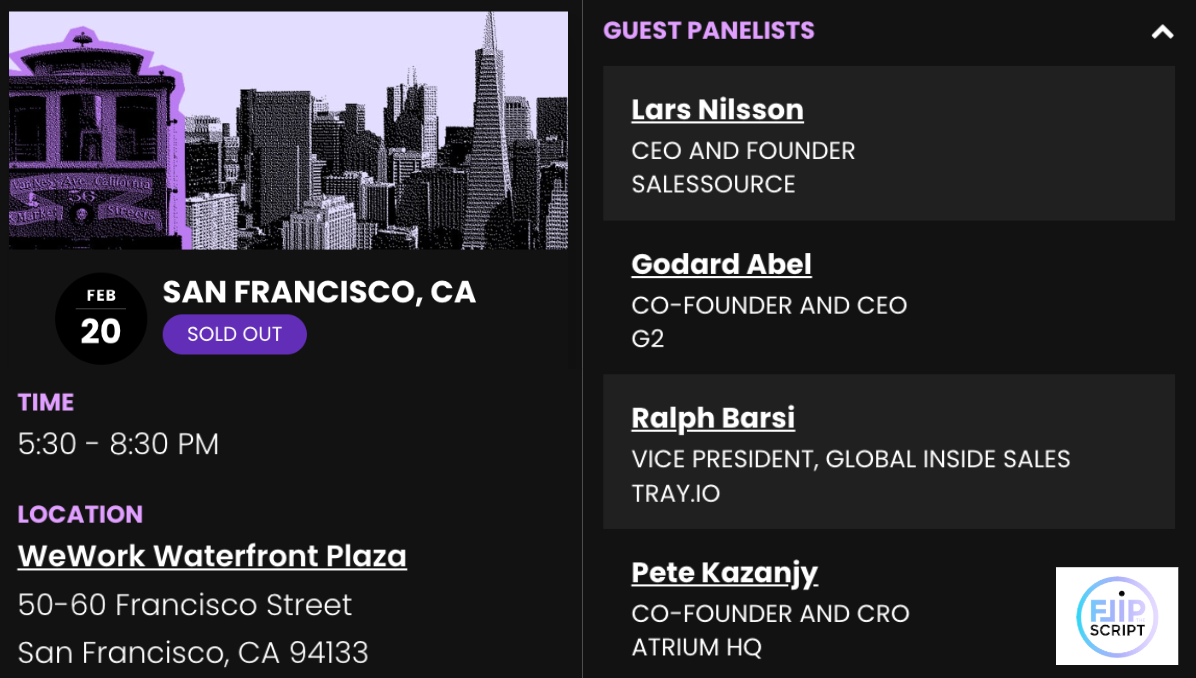
Flip the Script Tour 2000
Becc Holland, Scott Barker, Josh Braun
Lars Nilsson, Godard Abel, Pete Kazanjy, Ralph Barsi
February 20, 2000
Summary
This panel discussion brought together four sales development veterans with decades of combined experience building and scaling SDR organizations across startups and enterprise companies.
The conversation centered on what separates top-performing sales professionals from average performers, with each panelist sharing insights from their unique career journeys—from Lars Nilsson's foundational training at Xerox in the 1980s to Ralph Barsi's experience scaling ServiceNow's SDR team from 75 to 225 reps, to Godard Abel's entrepreneurial lessons building multiple SaaS companies including G2.
The panel emphasized that elite sales performance is less about innate charisma and more about coachability, process discipline, and mindset.
They discussed the importance of "fire in the belly"—an intrinsic drive that can't be taught—combined with tactical excellence in time management, self-accountability, and continuous learning.
The conversation also explored how to identify these traits during hiring, with panelists sharing specific interview techniques and red flags to watch for when building high-performing teams.
Throughout the discussion, the panelists challenged common misconceptions about sales, particularly the Hollywood stereotype of the smooth-talking closer.
Instead, they painted a picture of modern sales excellence as methodical, empathetic, and fundamentally about serving others while maintaining rigorous personal discipline.
The session concluded with each panelist sharing what they would tell their 23-year-old selves, offering both tactical advice and profound wisdom about building a meaningful career in sales.
BIG Takeaways
• Killer Attitude + Purpose-Driven Motivation Define Top Performers – Ralph Barsi identified that elite SDRs maintain what he calls a "killer attitude" by staying in the sunlight even during difficult stretches.
They understand that sales is a roller coaster with crummy days, weeks, and months, but they keep their goals small (working in 10-20 minute chunks) while playing the long game.
Critically, they all have a trigger or purpose beyond themselves—whether it's providing for family, proving something, or serving others—that transforms the role from being about their ego to being about something larger.
This combination of resilience and purpose allows them to recover quickly from setbacks and maintain consistent performance over time.
• Fire in the Belly Cannot Be Taught—Screen for It in Hiring – Lars Nilsson emphasized that he no longer believes past success predicts future success when hiring SDRs.
Instead, he looks for "fire in the belly"—an intrinsic drive that comes from upbringing and peer groups formed during formative years.
During interviews, he spends less time on where candidates succeeded or failed and more time understanding their background: Where did they grow up? What did they do during college summers?
If someone "blew off" summers when they were 18-21 and has nothing to show for it, he questions how seriously they'll take their career.
This fire manifests as fearlessness—top performers stand up at their desks making calls proudly rather than hiding in phone booths because they lack confidence.
You either have this quality or you don't, and it's crucial to screen for it during the hiring process.
• Extraordinary Coachability Accelerates Learning in Dynamic Environments – Pete Kazanjy shared that in early-stage companies where the product, market, and sales motion are constantly evolving, coachability is the differentiating factor.
He admitted that earlier in his career, having a high opinion of himself blocked him from accepting feedback, which slowed his growth. The best reps embrace feedback from managers, prospects, and peers as learning opportunities rather than responding defensively with "I know what I'm doing."
This openness creates exponential learning curves compared to resistant colleagues. For managers, Kazanjy recommends implementing radical candor—direct feedback that comes from a place of care but isn't sugarcoated—and having teams read Kim Scott's work so they understand the manager's perspective and can receive coaching more effectively.
• The 1% Compound Effect: Getting Better Every Single Call – Godard Abel observed that the best reps don't just listen during coaching sessions—they actively integrate lessons into their very next call.
When he shares a story or technique while helping a rep on a meeting, elite performers immediately make it part of their script and talk track.
This systematic approach to improvement, where you get 1% better with every interaction, creates massive compound gains over time. The growth mindset manifests in "parroting" successful colleagues, studying what works, and constantly refining their approach.
Abel noted that one of his top performers, Ryan, progressed from SDR to BDR to enterprise AE to team leader to head of revenue operations by relentlessly applying this principle of incremental daily improvement across multiple years.
• Structure Must Precede Freedom: The Jazz Music Framework for Sales – Ralph Barsi shared a powerful metaphor from jazz musician Branford Marsalis: "There cannot be freedom in jazz music unless there is structure first."
In sales, this means A-players can riff, improvise, and go outside bounds, but they always know where the guardrails are and what framework they must ultimately adhere to.
You need to know when to play your instrument and when not to, when to follow the process and when to deviate. Barsi compared this to ocean tides that can go out but must always return to the solid beach of structure.
For top performers, this means respecting company processes while exercising creativity within them, rather than viewing rules as constraints to rebel against. The freedom to improvise is earned through mastering the fundamentals first.
• Accountability and Authenticity as Modern Sales Superpowers – Scott Barker identified two critical traits for modern sales success: accountability and authenticity.
Accountability means being a team player but not reliant on anyone—you're 100% CEO of your territory and will do whatever necessary to hit your number.
If you need a case study to break into enterprise, you don't wait for marketing; you call your best customer, gather stats and quotes, learn Canva in three hours, build it yourself, then ask marketing to polish it.
Skills and knowledge are now democratized—you don't need three years of design school when tools make everything learnable in hours. Authenticity means embracing who you uniquely are, like Becc Holland does, and building your personal brand around that. In an era where technical skills are easily acquired, your authentic self becomes your sustainable competitive advantage because no one else can be you.
• Know Your Competitor as a Person, Not a Logo—Make It Personal – Lars Nilsson shared a tactical mindset shift that defined his sales career: he didn't compete against company logos like Kodak or Canon—he competed against Bill, the individual rep who had his same territory.
He knew if his competitor was male or female, studied their LinkedIn profile, understood where they won and lost, and made it personal.
This human-level competitive intelligence motivated him to get into his territory before his competitors and stay later than them. The thinking is psychological: when you believe you're better than a specific person whose face and background you know, you develop confidence and motivation that abstract corporate competition can't provide.
Finding "your Bill" and then systematically outworking and outthinking that specific individual creates both strategic clarity and emotional drive that generic motivational techniques cannot match.
Transcript
Pete Kazanjy (00:00):
...more than I wished had existed for me, because there wasn't really any Sales for Dummies book at the time. And then I started Atrium, so...
Scott Barker (00:11):
I love it. Connor, over to you, my man.
Godard Abel (00:14):
Sure. Anyone born after 1998? Anyone? Well, I have been doing SaaS for longer than you've been alive. I remember when I started for real in 1998. Does anyone remember the dotcom era? No.
It was actually a pretty exciting time. Actually, I started my first company at the tail end of the dotcom era, right at the beginning of 2000. I thought it was going to be really easy and fast work for another entrepreneur. Everyone at that time was going public in a year and it was really a crazy time.
(01:09):
But then I did start going to meetings to raise money. And in 2000, we raised dollars. In hindsight, I was very clueless.
Three years later, I remember we were almost bankrupt. We basically had a million left and barely any revenue. And actually, that's when I had to learn how to sell.
I did an MBA and Google Slides and all of a sudden, I'm like shit, I'm still not getting revenue. I'm going out of business. That was probably when things became real and I had to scale the company from 70 people, pay for everything, and I had to go all the way back to basics.
(01:54):
We also moved to Chicago from the Valley just to save money and started from there. And then I had to start cold calling people.
But that kind of met Matt, and he really taught me how to do that. He was incredible. I had to be my own CRO.
So I think learning how to sell was painful for me, but ultimately I think as an entrepreneur, you have to sell. You're constantly selling—to new people, investors, partners, friends, your wife, everyone, right? So that was very good for me.
(02:32):
Today what I'm building is called G2. Anyone heard of it? And Ryan, glad to see you.
One of the few members of our G2 team, he helped us build the community in 2014, also started out as a sales person. And now we're a few years later with significant growth. G2 provides reviews of software, but also we provide buyer intent data and can give you a lot of customer stories you can use to personalize your outreach.
But with that, I turn it over to Lars.
Lars Nilsson (03:09):
All right, so my name is Lars Nilsson. I got my start in sales right out of college. I joined a company called Xerox Corporation. I sold copiers, fax machines, and printers.
Godard Abel (03:23):
Copy machines? How do you know what a copy machine is?
Lars Nilsson (03:31):
It's the new typewriters. The reason why that's important for this group is that Xerox put me through an 11-month sales training onboarding program.
In other words, I had a desk, I had benefits, I got paid, but I wasn't expected to do anything until after I'd gone through rejection and negotiation training, objection handling training, presentation training. They sent me to different centers all over the country to do that. They gave me a manager.
Still, today, after 34 years of being out of college, best frontline sales manager that I've ever had. I learned what really, really good looked like—what onboarding, enablement, training, mentorship, and selling in frontline sales meant.
(04:23):
Secondly, I learned frontline sales leadership. That's important because 10 years later when I got into the Valley, at my first startup, there was no one in the company, including the founders, who knew anything about leadership or about frontline sales management. I had it all.
Not only did they put me through a management training program while I was selling, but I had some of the best managers I ever saw. I knew what really good looked like.
So anyway, I did that for five years. I ended up in the Valley in the mid-'90s, 1995 when Netscape went public and the whole dotcom craze happened. I happened to be at a rated company that didn't know what to do. And what happened was they went public, and it moved so fast.
I went from hardware rep to software rep. I didn't know what I was doing.
(05:14):
And instead of getting fired, I was asked to put a process in there for generating pipeline in the market. And so I started building a team.
Back then it was called telemarketing. When I got to five reps, my five reps looked at me and said, "Lars, why do you have me working for telemarketing?" And I'm like, "I don't know. Let's change this."
We got in a room, we got a couple of pizzas, we got a six-pack, or two. And we came up with BDR, SDR, and ISR, and we decided on SDR. And that was in 1997.
From then until now, I've been in the same two roles for venture-backed seed stage A to B software companies. That is, building SDR and BDR functions.
(05:59):
I've been at four companies, and I'm stupid lucky that all four companies ended up going public. From seed all the way to IPO.
I can tell you that other than the product, the leadership, and the money, there is no doubt that all four companies got to that level and that scale because of the SDR function. And so today, a lot of people know me for that.
(06:17):
I left two years ago to start a small strategic SDR and revenue operations advisory called Sift Systems. So we're running up to two years now helping to run SDR teams at a lot of the companies here in the Valley.
Scott Barker (06:47):
We're lucky to have you.
Ralph Barsi (06:47):
Quick round of applause from everybody in the room who's an account executive, individual contributor today. Round of applause for the SDRs in the house. Round of applause for the leaders who have people reporting to them in the house.
What does everybody else do? That's a pretty tepid response. Okay, it's good to meet everybody.
My name is Ralph Barsi. Today I run the global sales development organization at Tray.io, right here in San Francisco. I started my career in February 1994 as an account executive for United Parcel Service over in Oakland across the Bay.
Yep. Yeah, what's up Big Brown! I was there for just under six years.
(07:57):
You want to talk about catalyst events that light a fire under you...that you actually need to start selling a lot...have a kid! How about that?
So in October 1999, my oldest of three boys was born and that was some serious incentive that I had to get my act together. At the time, the dotcom boom was still happening. And so I jumped into CitySearch.com and started selling websites to businesses that did not have a presence on the web, let alone know what the web was.
So I went door to door throughout many cities in the Bay Area talking to people about this thing called the worldwide web, which is what we called it then versus the internet.
(08:43):
That led me to an SDR role where I used to share all the best practices that I was finding in my work with my peers. I would leave a voicemail, I would get called back. They didn't leave a voicemail, or it was a minute and 45 seconds long—they would not get a call back.
So I would share with them some of the insights, very tactically, very lovingly, about how to break that stuff down and make sure that you resonate with your audience. That earned me a job as the leader of that team and that was my first foray into leading sales development organizations, which has been a true passion of mine for a very long time.
(09:23):
Over the course of my roughly 25 years now in sales, half of it was spent as an individual contributor carrying a bag, running a territory, et cetera, while the latter half is really centered on building and leading sales development organizations in particular.
Prior to Tray, I led the team at ServiceNow. I got the team in 2015 when there were 75 SDRs. I left four years later when we were 225 people on the team in 15 offices.
I have been an SDR myself. I've been an AE myself. I've led very, very small teams through Series C companies as well as large publicly traded companies like ServiceNow.
It's a true honor to be here.
(10:10):
The aim I think for all of us is to share at least one nugget that you can go ahead and apply tonight. My hat is off to all of you.
It is Thursday night. You all want to get after it. You clearly made a decision in your heads that you want to be very successful in your career and in your profession.
And I just want to thank you for representing us and representing our profession and our craft. So thank you for being here tonight.
Scott Barker (10:40):
I love that. And Rob, you already got your takeaway. Everyone had a kid, right? That's the takeaway.
Okay Ralph, I want to go back to you on this one. So let's start with you because you had 225 reps at ServiceNow, which is an insane amount of reps. So what traits did the top one percenters have that the rest maybe were lacking a little bit?
Ralph Barsi (11:09):
Great question. Tough to answer because we could be here for a long time.
Traits. But the key ones were they had a killer attitude. They stayed in the sunlight. They understood that, look, our craft is a roller coaster ride. There were really crummy months. There were really crummy days. There were really crummy afternoons.
But there is another opportunity the next day or one hour later. So they would keep their goals small while playing the long game. Sometimes that meant working in 10-minute, 20-minute, 30-minute chunks. So that was a key trait.
(11:51):
Secondly is they had a purpose or a trigger. I mentioned my oldest son was born. If that's not a trigger, I don't know what it is.
I knew that immediately the role was no longer about Ralph Barsi. It was about my son. It was about my family.
And over time as I had more children and my boys grew up, I knew that I had to set an example no matter what on how to be of service to others, how to lead by example, how to illustrate kindness, how to look people in the eyes and get to know them by their first name. That's what the A player reps throughout my career have always done. And to this day I see that right now on my team.
So great attitude, understanding that we're all here trying to do our own thing and we all have our own individual issues that we're trying to overcome and navigate through.
(12:43):
And starting with some type of compassion and empathy. Understand that everybody's fighting their own battle and then meeting them where they are. Those are just a couple of the common traits that I've seen throughout my career.
Scott Barker (12:56):
So just want to double click on that. So drive and empathy are the two things I heard there. How did you test for those things, for the leaders in the room? How are you testing for drive?
Ralph Barsi (13:07):
Yeah, for the leaders in the room, if that's what you're trying to attract in your organization, you have to keep that in mind first. We're not here pursuing people. We're here to attract people.
So that means you as a leader need to be already illustrating that by example because A players don't want to play for B teams. They want to play for A teams and they want to play for A coaches.
(13:31):
So being mindful of how you're perceived in our marketplace and what the prospective candidates might think of you, your brand, your company, other people on your team. And then in the recruiting phase you have to be very careful about what job description you have out there, what it says, and what type of audience that description is attracting.
And then when you come in with interviewing your candidates, you're asking them about their proven track record. They could have delivered newspapers for the last two years, but if they took things from X to Y in that given timeframe and they can show you how they did it and precisely what they did to accomplish that, those are some key areas where you can actually gauge and quantify that type of track record.
Scott Barker (14:19):
Thanks for the advice. I like that. Lars, you were going to add to that on characteristics of these top performers.
Lars Nilsson (14:27):
Yeah. First of all, Ralph does a great job helping reps that are just starting out understand the power of personal brand. So if you Google Ralph Barsi personal brand, you'll probably come up with two or three different sessions at different summit events where you can listen to it. It's unbelievable.
I send all my new reps to listen to Ralph talk about how to build personal brand.
(14:54):
For me, I look for two things. Fear—you cannot be afraid if you want to go into sales. And the other thing I look for is a lot of people call it grit. I have a different name for it. I call it fire in the belly.
I used to think that the best predictor of future success was past success. That's not true. I don't believe that anymore. I believed that earlier in my career when the telemarketers I was hiring were 10, 15 years older than the ones that I'm hiring today.
(15:30):
What I realized is that fire in the belly, that thing that you either have or you don't, it comes from your upbringing partly. It comes from the peer group you had when you were in high school and college.
Because when you get out of college, you know what track you're on and you know where you're going. And so I spend a lot of my time in my interview not wanting to understand where they succeeded or failed. I want to understand their background.
Where did they grow up? What did they do during their college summers? If someone blew off summer when they were 18, 19, 20, 21, when they were adults, and they had nothing to show for it, how serious are you taking your life if you want to start as an SDR or sales representative at 22, 23?
(16:27):
So I spend a lot of time trying to understand does this individual have fire in the belly? And then if I hire them, when I hire them, I don't want them to be afraid.
When I come in the morning and I see a bunch of SDRs or ISRs going into phone booths because they're afraid to speak out loud and proud because they just don't know the script, you'd better figure that out before you get to work. Do that at home, practice in the mirror.
But don't come into my office and go into a room because you're embarrassed or don't have the confidence or self-esteem to talk about what you do.
(17:07):
I hired a guy, his name was incredible. I've never seen anything like it. Ever since he came in, whether it was 7:30 or 8:30 or 6:45, he was standing up on his desk and he was on the phone, and he was always talking to someone. So he got more connects than anyone that I'd ever seen.
He never dove into a phone booth. He never dove into a conference room. I think you cannot have any fear. You've got to have that fire in the belly. You just know. That will drive you to succeed in whatever you want to do.
Scott Barker (17:41):
Rob, I would love your take on this, too. You have 50-plus reps at G2 now and you mentioned Ryan, probably one of your unicorn reps who have now moved on to leadership. I know you don't directly manage them, but what red threads do you see in the top performers you have at G2?
Godard Abel (18:05):
Yeah, I was taken by that and I think we're actually getting close to 100 now. I didn't mention this in the beginning, but we built two companies before G2. The first one was almost a daily deals company. Second one was an enterprise sales force automation tool.
I think that Ryan did do a fantastic job for us. And I was also thinking about some other people on our team right now. Casey Rosengarten, another guy who was crushing it. More recently, Natalie on our team, who's an AE—she just got promoted after three years and she started as an SDR.
(18:37):
I'd say in building teams, I agree with everything that Lars and Ralph said about the fire in the belly. I think the other thing I really see is what you call the growth mindset. And I really say getting better every call.
And that's what I see. Some people listen, but they don't get better. With the best reps that I'm helping on a meeting, I think the good ones will take something from me, some story I tell, the way I tell it, and then they make it part of their next call.
And so I think it's getting better with every call and it's kind of a small thing, but if you do that every call, every day, it just really compounds.
(19:10):
I think listening to and parroting others I think is one of the best ways to do that. And doing it systematically, I do think that makes a huge difference.
And just to go back to Ryan since he's here, because he started out essentially doing SDR, BDR work, and then G2 didn't have an SDR team early on I don't think. We just had five very scrappy people doing outbound work in part-time.
But then Ryan kept learning and became an AE, became an enterprise rep, became a team leader. And now, he's kind of an alumnus, but now he's in revenue sales operations. And that's awesome to see people like that.
But I think what Ryan and those people do, they just get better at producing every day and they learn from others. They make their script, their talk track better, and if you just keep doing that, it really compounds.
Scott Barker (19:55):
Yeah, that 1% every single day—that does add up over time. And I imagine there's a lot of unicorn reps in the audience because you guys are all getting that 1% better tonight.
So Pete, I want to get your take on this, too. You're at Modern Sales Pros, you're absolutely surrounded by sales people everywhere you look. Same question. What do these people have that the rest seem to lack?
Pete Kazanjy (20:23):
Yeah, so I work with a lot of early-stage companies so I'm going to focus this advice tailored to smaller, maybe sub-20, sub-10 person sales orgs. And those organizations are a little different because usually the rate of change within the organization, the rate of change within the sales motion, and the rate of change in the product and how that fits with the market is actually very high, as compared to a more mature company where maybe sales processes are already figured out, the market's shaped itself out.
(20:55):
And so by virtue of the fact that early on things are so dynamic, the sellers have to be dynamic. And so the way that you do that—it's related to what Godard was saying about getting better every day—but the mechanism by which you're going to get better, and this is both something that you can do as an individual contributor or something that managers can look at and leaders can look at from a recruiting and also management standpoint, is be extraordinarily coachable.
Earlier in my career I wasn't very coachable. I think one of the personal failings I had was that I had a high opinion of myself. One of the problems...
Scott Barker (21:40):
This guy's got the best laugh.
Pete Kazanjy (21:46):
I think it's important to understand you can have confidence in yourself, but then the important thing is that that can block you from being coached. When somebody is offering you feedback, whether it's a manager or a prospect that you're jumping on a call with, or what have you, it's important to embrace that as a learning opportunity because that's going to accelerate your growth.
It is related to what Godard was saying. The reps that are the most coachable rather than being like, "Screw you, I know what I'm doing," but instead say, "Yeah, you know what? You probably are right. I probably messed up that objection. Or yeah, I guess I could tweak the way that I ran through that slide, or the way that I delivered that demo." It's just going to make it such that your speed of learning is going to be so much faster than if you're resistant to that.
(22:42):
So for the managers out there I would also say that being aggressive with providing direct feedback—I'm sure folks have probably heard of Kim Scott's book, Radical Candor. You can read the article on First Round Review; it's shorter. You get the same takeaway on it.
But just the notion of being able to both deliver direct feedback that comes from a place of care but isn't bullshit and isn't sugarcoated—that's going to accelerate the way that people learn. And then also one of the things I advocate for either entrepreneurs that I work with or managers that I work with is actually having their individual contributors read that First Round article, read the articles so they can understand where the manager is coming from so that you can take feedback well and you can take coaching well.
(23:30):
Because in a dynamic environment where everything is kind of moving at once... I was looking at name tags. There are a lot of you guys who work at very early-stage companies where the market's shaking out, the product's changing all the time, the messaging is changing all the time. You just got to be super coachable so you're going to accelerate as well.
Scott Barker (23:50):
Yeah, I love that. So true. And what's your name over there, man?
Sam (23:53):
Sam.
Scott Barker (23:54):
Sam. Thanks for keeping it light. Give it up for Sam. Sam's killing it.
Sam (24:04):
These are all founders of that space or obviously you've spent five years at that company.
Scott Barker (24:11):
Thanks for keeping it light, Sam. All right, I'll just quickly add something. So I've managed SDR teams myself in the past and now looking at Outreach and the growth we've had and looking at some of the top performers there, I see two things being a superpower in the modern sales era right now. And that's accountability and authenticity. Those are the two things for me right now that I see.
You'll just smash it if you embrace those two things.
(24:38):
And what I mean by accountability is you're a team player, but you're not reliant on anyone. Your success is yours, and you own that fully. You are 100% the CEO of your territory and you will do whatever is necessary to get that number, just like your company would die if you didn't get that number.
Even though you're lucky that you are supported by an organization, these people don't think like that. If you need a case study to break into the enterprise, you're not waiting for marketing to make it for you. You're calling your best enterprise customer, you're getting some cool stats from them, you're getting a quote, you're learning Canva or Tile in three hours and you're building it.
And then you walk over to marketing and say hey, can we polish this up? I need this for tomorrow.
(25:23):
And that's easy now. I always say skills and knowledge now are democratized. Meaning the playing field is level. You don't have to go to graphic design school for three years anymore. Everything is so easy to learn.
So if you have that hunger and that accountability, you can learn stuff and pick stuff up really quickly. So that's accountability. One more example is not relying on Salesforce admin or sales ops. If you need something to get done, go learn how to do it yourself.
We had a Google doc handed to us, right? Everyone's busy. You take that on.
(25:56):
And the last, authenticity. Again, it's very easy now to bridge the gap of skills because there's places like this, so you can become an amazing sales development leader, but you can never become a Beck Holland.
Beck Holland embraces her authenticity to the max. And I think that's going to become increasingly important for everyone in this room. It goes back to building that personal brand that Ralph talks about. I'll shut up now and keep this going.
(26:28):
Okay. So I want to spend a little bit of time on process. Pete, let's start with you. I know you're a big process guy. This is your world. So do you see these top performers—are they all following the process they're given or are they already pushing the boundaries? And how do you see them structuring their day?
Pete Kazanjy (26:57):
So, I guess it's kind of stage-specific, but let's assume you're in an environment where the sales motion is known and it's at least...we're not fully baked, but it's not jello. It's towards the custard stage.
I think the folks that are most successful there are process-oriented. One of the things I talk about a lot in my book—it's called Founding Sales and it's tailored toward founders—is dispelling misconceptions about sales.
Because a lot of folks have this... People who are not salespeople, their experience with sales comes from seeing things in movies, most of which are old nowadays. People have this perception that sales is shooting from the hip and being charismatic and persuasive. It is about being charismatic and persuasive, but in a methodical, process-oriented fashion.
(28:00):
The folks that I see have the most success really use structure in their lives, structure in their days, they have a process. They view themselves as being the CEO of their territory. They manage themselves like a manager. They are their own manager.
Some of the best kind of tactics there are being methodical—calendar management, slicing up your day. This is the time that I'm doing calling, this is the time when I pop back into my inbox and look for replies, this is when I go back and maybe there's intra-day cadence or operational rhythm, there's intra-week operational rhythms, there's intra-month operational rhythm. Just being partnered up and being methodical about it is really a differentiator.
(28:49):
Because in an environment where Slack is blowing up over here and Snap and Instagram are trying to distract you here and there's a bunch of bullshit on LinkedIn trying to distract you as well, there are tons of product managers out there who are compensated on distracting you such that your attention gets pulled to their app as opposed to what you're supposed to be doing. So to the extent that you can manage yourself and be methodical, you're going to be way ahead.
Scott Barker (29:17):
You have the laughing guy in the audience. Ralph, similar question. What is the time split that top performers in your eyes spend refining their craft versus executing?
Ralph Barsi (29:35):
That's a really tough one because it varies across the board. Going back to the structure and process question—my friend Richard Harris once said that sales is a lot like jazz music.
And for any jazz fans in the crowd, I highly encourage you if you've not yet seen it, there's a documentary about Branford Marsalis and it's called The Music Tells You. I don't even think they ever converted it from VHS to DVD. It is such a deep film.
And in that film, Branford is on a radio interview and he talks about freedom in jazz. He says that there cannot be freedom in jazz music unless there is structure first.
(30:24):
And the same applies to what we do every day. You can riff, you can go outside the bounds, you have to know when to play your instrument and when not to play your instrument, but you always know where those guardrails are. And you always know what that framework is that your company or your team or you yourself have to comply with and adhere to.
For the A players in the room, go do your thing, but respect the structure and respect the process.
(30:57):
It's like when the ocean tide goes out, guess what? It always comes back to the beach because the beach is solid and it is structure, and you too can return to the beach once you go out for a little bit, but you've got to come back. All right.
Scott Barker (31:10):
Love it, love it. I'm going to switch the questions. So we went process, let's go tactical. We are running... We got about 10 minutes. Lars, let's go tactical now. What are things, actions, that you've seen reps do that have put them on that top performer flow?
Lars Nilsson (31:33):
Well, it goes back to what you said. They never give an excuse. Perhaps you can find an excuse for underperformance. That's a hard one because you have to go into every day believing that you can do it.
It's not the new tool. It's not the compensation plan. It's not the territory. If those things all conspire and everyone's not doing well, then you're right. And that sometimes happens.
I look at resumes oftentimes and see people who had a bad year. It happens. It's okay. My company went under, but I did everything I could. Everyone has said it.
It is deciding what you're going to do during prime time hours.
(32:28):
I think it has a lot to do with what you decide to do before hours and after hours. And that's a tricky one because it depends on what you have at home or not.
Earlier in my career when I was a sales representative, I got into my territory before my competitors. I stayed in my territory after my competitors left. I actually knew who my competitors were—individual reps, not just their company.
I knew if they were male or female. We had the same path. So I wasn't competing against Kodak, I was competing against Bill, and that guy, I was going to beat.
(33:14):
In other words, my thinking is, know who you're competing against. It's not a company. It's not a logo. It's personal.
And if you believe that you are better than that person, first of all, find out who they are. Find out who they are, go to their LinkedIn profile, look at their background, and start laughing because you're better than them. And then go win.
Where they won, where they lost, understand their patterns.
(33:47):
And I think the best reps do as much before hours and after hours as they can, and they find the time. And again, respect for those that have families and that have personal lives. But you decided to go into this startup meat grinder of an industry, I think you do have to sacrifice.
I could have stayed at Xerox for 35 years. I didn't want to. I ended up at HP for a time and they got acquired. I couldn't stay there and take a deep breath for many years.
But I like this industry. I like what we do way too much to settle. I'm not saying I wouldn't change my standards. You don't have to work that hard because no one has to know where you are. But it was also not easy.
If it takes you five years from now, think about where you'll be. Every single day, everyone in this room, you move the needle for your company by getting that data or by moving a deal from stage two to stage three or by closing the deal. That's what I think about.
Scott Barker (34:57):
That's great. And I think we got a new hashtag for the evening. Hashtag "find your Bill." That's going to be trending tonight.
I got the five-minute warning here. So I love asking this question, especially with the careers that all you gentlemen have had. Godard, I'll start with you. Let's say I have a time machine. I just built it, come on over, come in the time machine. You get to go back to yourself when you're 23 years old, what do you tell Godard at 23?
Godard Abel (35:25):
You don't have to spend any money on that MBA.
Scott Barker (35:25):
That's a mic drop. Pete, what do you tell yourself at 23?
Pete Kazanjy (35:46):
Probably just adopt a learning mindset, a continuous learning mindset. One thing I wanted to recommend on tactics—what Lars was saying earlier about managing yourself—there's a book by Jason Jordan called Cracking the Sales Management Code.
It's got really good insights and will make you way better at your job. And just have a learning mindset. We are all peers of learning, so already good on you. But just adopting a learning mindset and continuous learning mindset is incredibly powerful.
Scott Barker (36:15):
Okay. I'll share one quick thing that we say at Outreach and I think that is great advice for any AE in here: use what we call a fireball effect.
So the best reps, although they take complete accountability, they're not going to battle alone. They're leveraging all their executives. They're leveraging everyone in the organization to help them succeed.
So know that your organization does have your back and you just got to find ways to enable that. Lars, time machine, go back, 23 years old. What do you say?
Lars Nilsson (36:53):
So we have this thing we call it five before nine and five after five. Those are the five calls you made before the workday started, and five calls you made after the workday ended.
I would tell myself 10 before and 10 after. I say that because in three or four years of selling, it breaks down to basics. Selling is just activities.
It's meetings, it's phone calls, it's emails, it's different concepts, it's demos, it's dinners. That's all it is. There is a little bit of redundancy.
Get better and more efficient and get more in before, during, and after work hours. I always say everyone that is in sales, we have to be ready to grind. If that's what you want, I will put you to work and then we'll make more money than you can think about.
That's always been my philosophy. It's why I've always been in sales. That's how I am. I'm an old school guy.
(37:52):
Being in sales has offered me the ability to travel and create memories and build a life.
Scott Barker (38:01):
Ralph, bring us home, my man.
Ralph Barsi (38:08):
Yeah. Three quick things. Number one, to my 23-year-old self: Dude, enjoy your hair while you have it. That's number one, no question. It was such good hair too.
Number two, stop thinking about yourself. Start thinking about other people. Start encouraging others if you're discouraged. Stop thinking about you. Get out of your head. Face outward.
Number three, when you're doing that, you're going to show and share your work. So start chronicling all the things you're doing. The pipeline you're building, the deals you're bringing over the line.
Start chronicling it, documenting how you feel through the process. Learn as if you need to teach someone the very next day what you're learning. Leave behind a trail of value that will ultimately become your legacy.
(39:02):
That's what I would tell myself. And I'd give myself a big hug.
Scott Barker (39:01):
That's a perfect way to wrap up. Gentlemen, thank you so much for your insights tonight. We'll take a quick 10-minute break and we'll be back with live calling.