🎙️Transcript: Mentoring for Impact
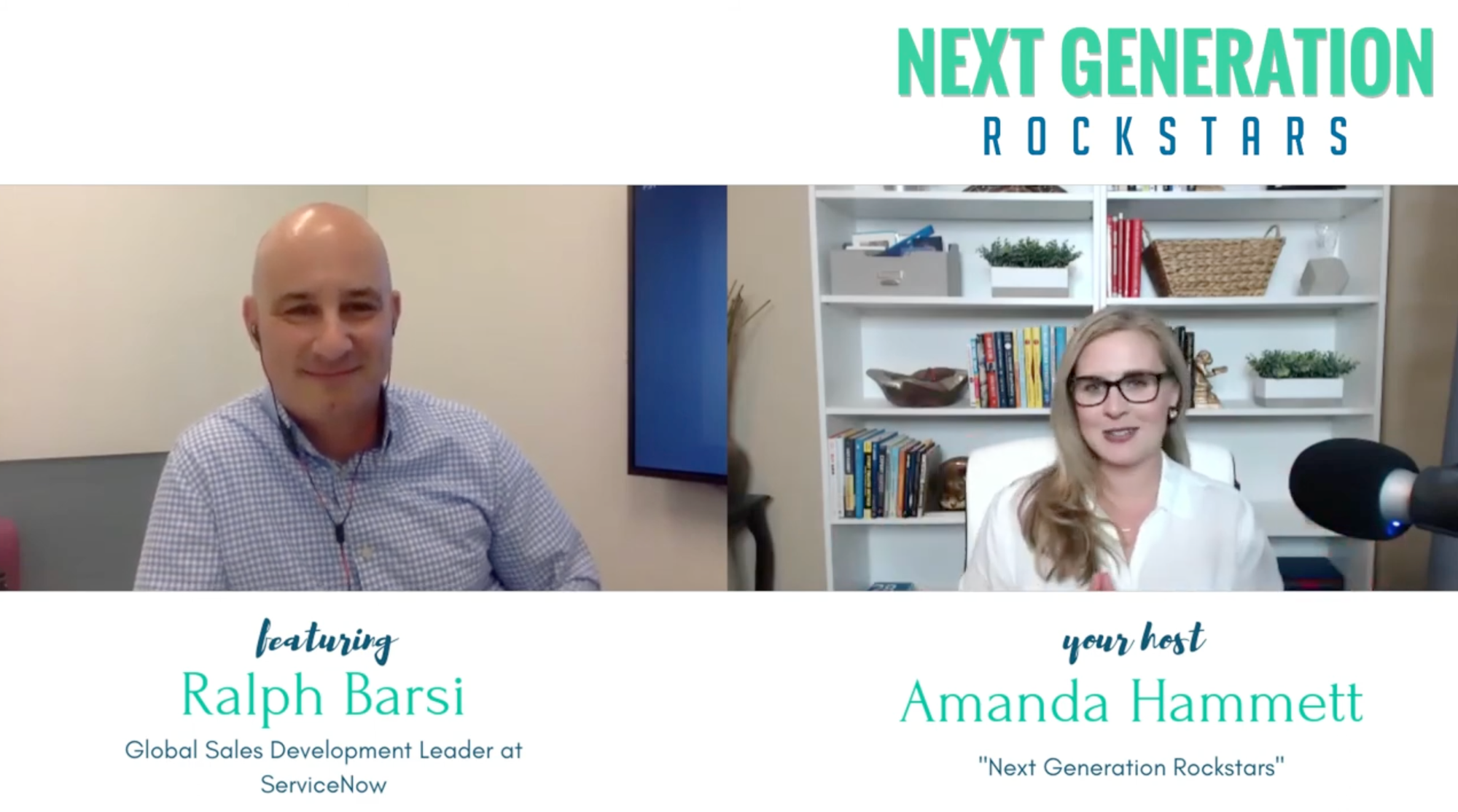
Next Generation Rockstars Podcast
"Mentoring for Impact"
Amanda Hammett, Ralph Barsi
August 8, 2019
Summary
Amanda Hammett brings Ralph Barsi back for a second episode of the Next Generation Rockstars Podcast, making him the only guest invited for a round two.
The focus this time is mentoring, a topic they didn't get to in their first conversation. Ralph defines mentoring as a combination of teacher, coach, and guide for someone who wants to level up and is vulnerable enough to ask for help.
He cites the Zen proverb "when the pupil is ready, the master appears," emphasizing that mentors won't surface until you commit to finding them.
The conversation covers practical frameworks for both mentors and mentees. Ralph advises potential mentees to write everything out, beginning with the end in mind, identifying short, mid, and long-term goals, and boiling it down to essentials before approaching a mentor.
He references SMART goals and the "plan on a page" concept used at ServiceNow. For mentors, Ralph sees the role as listening, helping mentees connect the dots, removing obstacles, and asking questions so mentees arrive at answers themselves rather than just giving directives.
Ralph discusses two mentees he works with, Nicolette Mullenix and Morgan J. Ingram, both of whom approached him systematically and have become rockstars in their own right.
He notes that 71% of Fortune 500 companies have formal mentoring programs, and studies show mentors are 86% more likely to stay with companies that have solid mentorship programs.
When asked what he gets from mentoring, Ralph shares that he believes it's his vocation: "I do feel like that's why I'm on this planet, is really to serve others and to lead by example and illustrate what servant leadership really is."
He wants his three boys to grow up to be "men for others," and if the ripple effect positively impacts others, even better.
BIG Takeaways
"When the Pupil Is Ready, the Master Appears" - Ralph cites this Zen proverb to explain that mentors won't surface until you commit to finding them. You have to decide first that you're committed to finding that person, then the universe will conspire to put them in your path. It's the same law as "seek and you shall find."
A Mentor Is a Teacher, Coach, and Guide Combined - A mentee is someone who wants to level up and is vulnerable enough to ask for help. The mentor sheds light and shares insights based on experience, shining the spotlight in places the mentee isn't considering. This combination of roles defines what a real mentor is.
Write It Out Before Approaching a Mentor - Ralph advises potential mentees to spill everything onto paper: what's bothering you, what challenges keep recurring, what patterns you've identified. Boil it down to essentials so your first conversation is concise and clear. "Help me help you. It's that simple."
The Best Mentors Ask Questions, Not Give Answers - Rather than parachuting in with directives, great mentors ask questions so mentees arrive at answers themselves. "Why is that goal important? How would you visualize yourself having already accomplished it? Who would you pay this forward to?" That's what the best mentors do.
71% of Fortune 500 Companies Have Formal Mentoring Programs - This means frameworks are searchable and adaptable for any company. Benefits include employees who feel celebrated not tolerated, killer retention and promotion rates, and a culture where people pay forward their experiences. Mentors are 86% more likely to stay with companies that have solid programs.
Great Mentees Are Specific, Personal, and Resourceful - When Ralph is approached to mentor, he looks for people who offer a skeleton of what they're trying to get from the relationship. He does due diligence by checking their LinkedIn and Googling them. If he finds nothing, that becomes the first conversation: "It's very hard to learn about you. Let's start there."
Mentoring Is His Vocation - When asked what he gets from mentoring, Ralph says he believes it's why he's on this planet: to serve others and illustrate servant leadership. He thinks globally and acts locally, starting with being a great example for his three boys so they grow up to be "men for others." The ripple effect is the bonus.
Transcript
Amanda Hammett (00:00):
Welcome to the Next Generation Rockstars Podcast. If you are trying to figure out how do you recruit and retain this next generation of rockstar talent, well, you are in the right place.
Hey there everybody. My name is Amanda Hammett and today on The Next Generation Rockstars, we have round two with Ralph Barsi. Now, if you have been following us, you know that Ralph was on a couple weeks ago and he shared with us just all kinds of knowledge bombs. So you need to go back and check that episode out if you missed it. But today we have Ralph Barsi back from ServiceNow. Ralph, welcome to the show.
Ralph Barsi (00:38):
Thanks, Amanda. It's great to be back. Thanks for having me again. I appreciate it.
Amanda Hammett (00:41):
No worries. Well, I will tell you, Ralph, you are the only person who has been invited back for a round two.
Ralph Barsi (00:47):
Yay. Okay. Flattered.
Amanda Hammett (00:52):
That's awesome. So the whole reason I originally reached out to you was to talk about mentoring because I know a couple of people that you mentor, but we had so much to talk about the last time. We didn't even get to it. So we had to do a round two.
Ralph Barsi (01:08):
Here we are. You're right. We had a good conversation last time. So I would encourage any of the viewers today go back and take a look at our first conversation before you continue on with this one and you'll see how we're picking up where we left off.
I'm glad we could talk about mentoring and mentorship. It's an important craft and it's something that I think more people need to take advantage of on both sides, both the mentors and the mentees. So I'm looking forward to getting into it.
Amanda Hammett (01:34):
Awesome. So let's start basic level. How do you define mentoring for yourself?
Ralph Barsi (01:42):
To me, a mentor... well, let's start first on the mentee side. Someone who is a mentee looking for a mentor, someone who wants to level up. They want to improve in their profession, in their craft, in life. And they are vulnerable enough to ask for a guide or a coach or a teacher or someone who could shed light and share insights based on their experiences to maybe shine the spotlight in places that the mentee's not considering or even thinking about.
And so it's a combination of that teacher, coach, guide. In my definition, that kind of rolls into what a real mentor is.
Amanda Hammett (02:28):
That's a great, great definition. I love that you started out with the leveling up, but also the teacher, coach, guide. I think that word guide is really key.
Ralph Barsi (02:39):
Absolutely. There's a great Zen saying, I think it's a Zen proverb: "When the pupil is ready, the master appears."
Amanda Hammett (02:48):
Yes.
Ralph Barsi (02:48):
And it's the exact same law that states "seek and you shall find." So if you really want to level up and you want to start finding a guide or teacher or mentor to kind of walk the path with you, they won't appear until you start looking for them.
So you have to decide first on your own that you're committed to finding that person or those people, and you'll be amazed how they surface. They will show up. The universe will conspire to put them in your path. So it's a super optimistic, positive thing to think about if you really want to go that route.
Amanda Hammett (03:31):
I love it. Yes, you're absolutely correct. Now, I would assume that you have had, over the years, some pretty amazing mentors that have really modeled this for you.
Ralph Barsi (03:43):
I have personally and professionally. I've had mentors that I didn't even ask to have as mentors. People who've just kind of noticed that I was looking to improve in certain areas and they were able to offer some wisdom and knowledge.
And I'm pretty open and transparent and candid anyway. So I can always get better on my listening skills and I can always get better on how I hear and accept and apply feedback. That has been super tough for me throughout life and still is, but I think I've improved quite a bit over the last several years in just hearing people's feedback of me and about me and how I can turn the dial in certain spots to just be a better person.
Amanda Hammett (04:36):
I think that we could all use that feedback and sometimes it is tough to take and it hurts a little bit.
Ralph Barsi (04:44):
Totally. And a lot of people will say, "Feedback is a gift." And sure, thank you. I appreciate the gift, but I don't like the gift all the time. You're right.
Amanda Hammett (04:57):
I've had those moments where people have told me, "But it's a gift." And I'm like...
Ralph Barsi (05:01):
Yeah, it stings a little bit. So let's talk about mentoring and let's talk about it, whether it's personal, professional, and maybe you could share too with the audience, tell us about your mentors and your experience with mentoring.
Amanda Hammett (05:16):
Absolutely. It's funny that you mentioned a little while ago that, what was it, the proverb, basically when the pupil is ready, that the teacher will appear. And that really resonated with me because that has been the case for me, especially the past five, ten years of my career where I felt like I was in this area and I felt like I had something extra to give, but there wasn't really a defined place for me.
And so I was really reaching and trying to find that place. How do I start this place? And I was searching and searching and she did. She appeared and she has been a pioneer in her own field and she was like, she really helped me wrap my head around it. And it's been a beautiful learning and teaching experience for me and now I'm just really fortunate that she's come to me recently and said, "I am so proud of what you have been able to accomplish."
And to me, that is like the best gift I could have gotten because she's recognized how hard I've had to work to get to where I am.
Ralph Barsi (06:30):
Yeah. It means the world, especially to... mentors really care. They really care about you moving the needle in your own life. And when you can illustrate that progress and then you've got the gratitude and the awareness of how far you've come, that means the world to mentors and that's what it's all about.
And it's not uncommon, Amanda, what you mentioned, how you're trying to wrap your head around it, you know you need some help in some areas, but you're not quite sure how to get started, what step one is, et cetera. So many people feel that way.
(07:10):
So what's really important for those listening and watching who are just contemplating whether or not they want to take that leap and kind of get into a mentorship relationship, write it out. I mean, just spill it all out onto paper and use the concept of beginning with the end in mind.
What short, mid, and long term outcomes are even important to you. And you and I started to talk about this in our last talk. Kind of do a thorough self-assessment and identify what those short, mid, and long term goals are, and also identify how you define what short, mid, and long term means.
(07:47):
It means something differently to all of us. And I would highly recommend, again, spilling it all out, really writing it all out, what's bothering you, what challenges you're encountering over and over again, what patterns you've identified and what you want to fix and then boil it down to the essentials.
So that when you do have those initial conversations with your mentor, it's concise, it's simplified, it's a clearer path to where you're trying to get, and that's going to help them help you.
Otherwise you're going to experience what both you and I have experienced and you're like, "Hmm, I think I need help. I'm just not quite sure where and what." Well, hey, if I were a mentor listening to that, I don't even know where to start either. So help me help you. It's that simple.
Amanda Hammett (08:39):
Absolutely. And one thing that I would add to those short, mid, and long term goals and really looking at yourself where you are is being honest with yourself with where you are because it is very easy in today's world to really start to compare. It's like, "Oh no, I can do this well." And it's like, "Well, is it world class or is it I can get by?"
Ralph Barsi (09:05):
Yeah, what will come from those types of questions and assessments is perhaps you create SMART goals. What's the acronym again? Help me. I think it's simple, it's measured, it's actionable, reasonable or realistic and...
Amanda Hammett (09:24):
Timely. Yes.
Ralph Barsi (09:25):
So if you think about those categories when you're writing down your goals and you really make it easy for the two of you to measure your progress, that's a huge step that you could take.
Perhaps it becomes a plan on a page. A lot of businesses do this. We do it all over ServiceNow. For example, we have a plan on a page with what our top three to five initiatives are and kind of what rolls into accomplishing those initiatives. And perhaps one page on yourself and your assessments and your goals is really going to help the two of you get the conversation started. And that's where your mentor can really weigh in and help you kind of tailor it or frame it up in a more proper way for the two of you to move forward on.
Amanda Hammett (10:14):
I agree. So let me ask you this, and you've kind of touched on this a little bit, but what really, as a mentor, what is your role? What is your role?
Ralph Barsi (10:28):
Wow, what a good question. What a broad answer I can give you for that. The way I see it, number one, I'm here to listen. I'm here to listen and ultimately what I'm here to do is help you connect the dots to get to where you want to go.
Amanda Hammett (10:46):
Oh, yes.
Ralph Barsi (10:48):
And if I see some obstacles that are on your path, I have to help mitigate the obstacles or make the obstacles appear smaller than they are because you're so focused on producing high quality work, moving yourself forward, you have an intensity level of focus, you have a set time that you are going to invest in working towards your goals, and I help you get there.
Ultimately, the best mentors ask questions. They ask questions so that you, Amanda, can arrive at the answer yourself. We don't parachute in and go, "Hey, look, thanks so much for the SMART goals. Here's what you're going to want to do for A, B, C, and D."
(11:35):
Instead, we'll ask, "Well, why is that an important goal of yours?" And if you were to stack rank these top three goals, what would be the first one you'd really want to accomplish versus the last one and why?
How can you visualize yourself having already accomplished these goals? What type of person would you be like? How would you be talking to me if those goals were already accomplished? Who would you pay this forward to? Who would you go help knowing what you don't know yet?
Amanda Hammett (12:06):
Yes.
Ralph Barsi (12:07):
That's how I see a mentor. That's what mentors do. That's what the best mentors do.
Amanda Hammett (12:12):
I would agree with you. I would agree with you.
And another thing that my mentors have done for me is they have challenged my thinking. And sometimes there have been times where I've been thinking maybe too small and this one mentor in particular, she was just like, "Yeah, you can totally do that, but..." And I always knew when she said that, I knew she's about to give me a mental butt kicking, but I need it. It's healthy.
It was, it was. And she really pushed me to be uncomfortable in a lot of ways. And it was a wonderful gift because now I live a lot of my business life in a state of semi-discomfort and that's okay. I've gotten really comfortable with it.
Ralph Barsi (12:57):
Well, that discomfort equals growth. Growth is on its way. And if I were your mentor, for example, I'd want to make sure I kept you accountable on what you said you were going to do.
Amanda Hammett (13:09):
Yes.
Ralph Barsi (13:11):
Yeah. And just kept your focus on it. There may be instances where you bring up areas that you're trying to improve in, and I might know people in my network that are going to do a way better job of kind of teasing out the best in you than I would in those areas.
So I would broker introductions and make sure that you're expanding your network and adding value to it at the same time. As we've talked about before, the more value you add, the more valuable you become in the process. And it's just really important to add value even in the smallest of increments.
Amanda Hammett (13:46):
Absolutely. So what I've been seeing a lot lately are companies have been coming to me to either help them create or tweak or completely revamp an internal mentoring program. And it's always really interesting to see that dynamic within a company. I assume that ServiceNow, you've kind of alluded to one earlier. I assume that you guys have one. So what do you think is the benefit to a company to have an internal mentoring program?
Ralph Barsi (14:16):
Sure. A great question. And yeah, we'll just focus on professional for a minute. So I read a study recently. Now I read it recently, but the study is probably two years old and it said that 71% of the Fortune 500 companies have formal mentoring programs. So that's a good thing.
That's a good thing in that over two thirds of them are believing in this. And it also means that just through simple Google search, you could start to find the frameworks that these Fortune 500 companies are using to drive their mentoring programs. And you can take pieces or parts of it and create your own mentoring program in your own company. You don't have to be a Fortune 500 company to drive it.
(15:10):
So I have seen not only in ServiceNow, but in the other companies I've worked with, not only at the macro level where the company offers a program, but at the micro level where, for example, my sales development organization, we too have our own mentorship program within the company.
The benefits are boundless, really. I mean, number one, you've got employees who are engaged.
(15:30):
They feel like they're in a place where they're celebrated, not tolerated. They feel like their accomplishments are being recognized at the very least by their mentors. They feel like it's a place that they can grow and thrive.
So from a company's pulse standpoint, you've got killer retention rates and you've got killer promotion rates because you have employees who believe in themselves and are actively working to improve their game.
So they're staying in their companies, they're being promoted within their companies, and then ultimately they're paying forward the great experiences they've had with mentors to help others grow in their own right.
(16:20):
So, I mean, and that's just a couple benefits. It just goes on and on, but I can't emphasize enough the importance of having one in your company or starting one. If there isn't one, maybe that's a sign that you need to kind of light a fire under yourself and get that mentorship program started. Be the one carrying the torch.
Amanda Hammett (16:35):
Absolutely. Well, and something else is really interesting. There's some studies out there that actually suggest that not only does the mentee really benefit, but the mentor themselves actually benefits. And when there is a solid mentorship program in place, actually the mentor is 86% more likely to stay with the company.
Ralph Barsi (17:00):
Yep, I believe it.
Amanda Hammett (17:04):
So I mean, the mentor, the person actually helping and guiding and teaching and coaching, they tend to stick around for those types of things. And that is something that is a beautiful thing that companies are always coming to me like, "Oh, we have this whole gap between 27 and like 47. How do we fill it?" I'm like, "Let them teach, let them guide. Let them go."
Ralph Barsi (17:27):
That's exactly right. There's a great business leader and thought leader out there. His name is Ramit Sethi. Have you heard of Ramit?
Amanda Hammett (17:35):
Yes. Oh yes, yes. I follow him.
Ralph Barsi (17:37):
So he's the author of the book, I Will Teach You to Be Rich. So his background really stems from finance, personal finance. Anyway, Ramit has written a ton of great content and material on mentorship programs.
And there's one article I wrote down and the title is Why Successful People Don't Want to Mentor You. So I suggest you look that one up and read the details behind it.
And then another great article he wrote was Meet My Mentor Jay Abraham, who's a marketing master, and learn how to find your own mentor. So I would recommend people searching for those two. And maybe in show notes, Amanda, we can include links to those articles.
(18:20):
But it really offers great tactical advice on how to approach mentors for the first time, how to ask for their time.
Another great concept I think about is Simon Sinek's Golden Circle where the bullseye is why and then how and then what. Those are some questions you should be asking yourself before approaching a mentor.
And if you are a mentor being approached by a potential mentee, have them answer those questions. Why are you coming to me? How are we going to do this? How's it going to work? And then what is it going to entail?
And I think it's just a great beginning, middle, end to think about for both parties to really establish a solid, long lasting relationship.
Amanda Hammett (19:07):
Absolutely. So I would imagine that you're the type of guy that's probably approached to be a mentor a lot. And how do you decide who... you can't take them all on. You just can't. And so is it really when they come to you and they've already got this kind of outline or is it, do you take on the cases where they're just spinning in their head or how do you make that decision?
Ralph Barsi (19:34):
It's more the former than the latter. If someone comes to me and they are personal, they are specific and they at least offer a skeleton of what it is they're trying to get out of this relationship, I will absolutely take it into consideration.
You also have to think about we're all crazy busy. So if I can serve and accommodate them through my schedule, then I will absolutely, even if it's an initial phone call and we decide together that, you might want to talk to Amanda. I'm going to connect you with her. She might be somebody who's going to have the bandwidth and is also going to have the expertise and experience in these specific areas since you called them out and could probably be a better help than I can.
(20:20):
In fact, that recently happened. Somebody reached out to me on LinkedIn asking if I'd consider mentoring them and they're based in Germany and time zones alone are going to be tough. And then you talk about language barriers and just, you don't want things lost in translation.
So because they provided some specifics on what X to Y means to them, I've put them in touch with some of my leaders and colleagues in Frankfurt and in Munich because I already know that these leaders can bring so much value to the table for this individual and they're in Germany. It's just a lot more effective for that person than I could be living in the San Francisco Bay Area.
(21:00):
So those are the examples. The best mentors and even the best mentees are very resourceful. Mentees are ones that really do their due diligence to find out why do I want to contact Amanda or why do I want to contact Ralph?
And in turn, we need to do our due diligence to see, well, what does this person's LinkedIn profile look like? If I Google this person's name, what will I learn about this person? Some of them, I'll learn nothing. I'll hear crickets chirping because they've done nothing in the marketplace or in their community to add value.
And that might be a very good first topic for our first talk.
Amanda Hammett (21:44):
Right.
Ralph Barsi (21:45):
"Hey, you're trying to build your brand. Well, it's very hard to learn about you and what it is you bring to the table. Let's start there." And that's usually a pretty good talk. Long answer to your question, but those are some components that I consider if someone's to approach me.
Amanda Hammett (22:00):
Absolutely. Well, as I've told you before, I happen to be familiar with a couple of people that you mentor. A few people, Nicolette Mullinax and Morgan J. Ingram, they are both rock stars in their own right.
Ralph Barsi (22:15):
Yes, they are.
Amanda Hammett (22:16):
And Nicolette actually was the one who initially was like, "You might want to speak with Ralph." And she told me, she walked me through how she really approached you because she does not work with you, nor does Morgan.
And it was really, and she seemed to have a very systematic approach to how she... I don't know how it came across to you, but how she went about approaching you to be her mentor. And she's killing it. So I think she's doing okay these days.
Ralph Barsi (22:46):
Yeah. She and Morgan are both killing it and will continue to. They've got that moxie and they've also got that fire in them that just wants to be better all the time. They hold themselves to very high standards, higher than I can hold them to or you can hold them to.
And there's a lot of there there when you've got a potential mentee who's just got that fire burning. And if you don't help them, they will go find someone else who will. And you just got to love that.
And yeah, Nicolette and Morgan are both rock stars, to use your words. And there's no question they're going to continue to be very successful in their career. And what I love is both of them will continue to help others as well.
Amanda Hammett (23:28):
That is correct.
Ralph Barsi (23:28):
They'll give back and they'll impact lives along the way, which is really what it's all about.
Amanda Hammett (23:34):
Absolutely. I mean, Nicolette is running a fairly substantial team these days. And Morgan has quite the LinkedIn following where he gives tips and tricks on being a sales rep. And he's just... I'm always amazed with the stuff that he puts out and just the way he looks at things and just his positivity just on a day to day basis.
Ralph Barsi (23:57):
Yeah, it's infectious. It is. Yeah. That enthusiasm's infectious. And like you said, I mean, both Morgan and Nicolette, they're placing morsels every single day into the community and those morsels are there to help others.
And not everybody will gravitate towards some of those nuggets. A lot of people will, and those who do and actually apply what they're learning from those two will do a lot of good in the world. And that just warms my heart.
Amanda Hammett (24:29):
Absolutely. So, well, you actually kind of segued into my next question. What really is the benefit for you to become a mentor? How does it benefit you besides warming your heart?
Ralph Barsi (24:44):
Wow, that's a tough question. And we're getting a little personal here, which I don't mind, but I have believed for a very long time that that's why I'm here. This is my vocation.
Some people in the professional world see me as a sales development leader. Okay, great. If that's the channel or the vehicle that I'm going to use to impact people in a very positive way, then so be it. But I do feel like that's why I'm on this planet is really to serve others and to lead by example and illustrate what servant leadership really is.
(25:25):
Everyone's got their opinions of it. Some people aren't fans of it. Some people think it's a lot of fluff and I'm okay with that. I actually respect everybody's opinion. We all have different experiences and insights and we come from different places in the world. That's okay.
As long as you are using your unique strengths and gifts to make the world a better place, that's really why we're here anyway.
(25:47):
So I don't know if it's the process of leaving behind a legacy. If I think globally and act locally, I'm going to start thinking about my three boys and being a great leader by example for them so that they can grow up to be men for others.
I'm fine with just that, but if it positively impacts others in the ripple effect, then that's even better. But I hate to break it to you, Amanda, but yeah, it's because it just warms my heart.
Amanda Hammett (26:16):
No, and that's perfectly okay. But I mean, you really are leaving a legacy. You really are creating that ripple that will go out. The Morgans of the world, the Nicolettes of the world, they're taking your teachings and they're spreading with their own spin and their own take on it, but they're spreading it and they're touching other people's lives.
And I think that you're... not to say you can hang it up, but mission accomplished, like you're doing that, you're accomplishing your goal with what you set out to do in this world.
Ralph Barsi (26:49):
Thanks, Amanda. I appreciate that, but candidly, I'm not really the source. I'm simply replicating goodness I've seen from others along my career path and in my life, just so many different people I've just taken examples from and said, "Yeah, that's the way to do it. That's the way to roll."
And so that's great to hear. And yeah, I want to make sure Nicolette and Morgan see this and I want to make sure that people who don't know who they are, look them up and even reach out to them, tell them, you know, thank them for the impact that they're making.
Amanda Hammett (27:22):
Absolutely. Yeah. And they both are. And I had Morgan on the show last season. I'm going to have Nicolette on this show next season. So absolutely people will be hearing from them for sure from this platform.
But I want to wrap this up with just this. You said in the last episode that we did together that A players want to play with other A players.
And the way that I see it is that you are an A player because you are not only great at your job, but you're great at developing others to be great at their job. Whatever that means to them, whatever that success, long term, short term means to them, you're great at it.
And we see that in Nicolette, we see that in Morgan and there are others out there just like that. So I for one like to say thank you, but I would just encourage you to keep on doing what you're doing. I know that you will, you don't have to hear that from me, but thank you. Thank you so much for me and from the world as a whole. Thank you.
Ralph Barsi (28:25):
Thank you, Amanda. I appreciate that very much.
Amanda Hammett (28:27):
Well, wonderful. Well, thank you guys for being with us and thank Ralph for the impact and the ripple effect that he is having across the world and changing lives every single day.
And thank you guys for joining us and we will see you in the very next episode. Thanks so much for joining us for this episode of The Next Generation Rockstars, where we have discussed all about recruiting and retaining that next generation of talent.
So I'm guessing that you probably learned a tremendous amount from this week's rockstar leader. And if that is the case, don't keep me a secret. Share this episode with the world, but really share it with your friends, with your colleagues, because they also need to learn how to recruit and retain this next generation of talent because these skills are crucial to business success moving forward.
Now, of course, I want you to keep up to date every single week as we are dropping each and every episode. So be sure to subscribe to your favorite podcast platform of your choice and you will see the Next Generation Rockstars show up just for you.