🎙️Transcript: The Sales Career Podcast
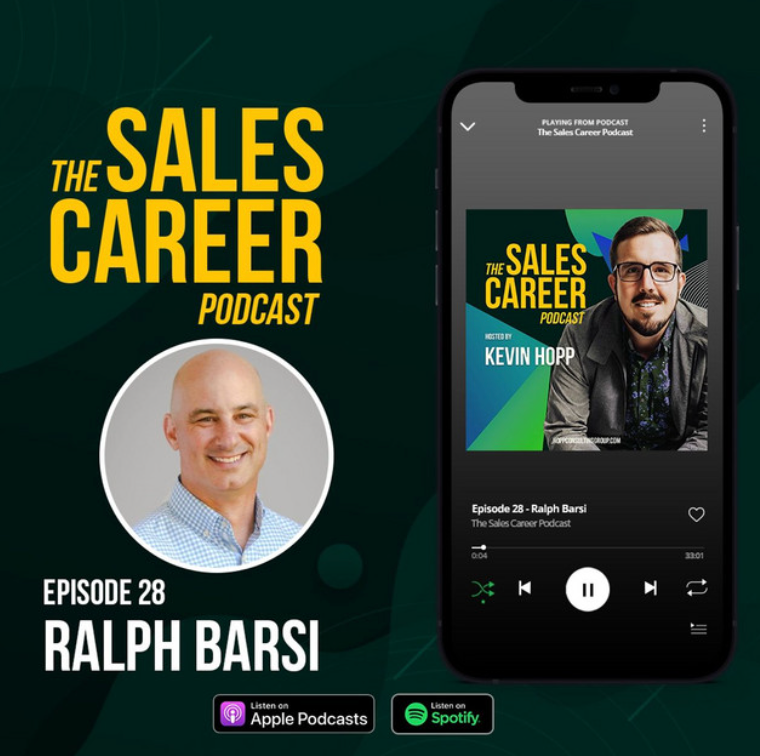
The Sales Career Podcast with Kevin Hopp
"Invest in Your Network"
Ralph Barsi
May 12, 2022
Summary
In this Sales Career Podcast episode, host Kevin Hopp interviews Ralph Barsi (VP Global Inside Sales at Tray.io) about his 29-year sales career journey from UPS account executive through door-to-door citysearch.com sales to leading 220+ person global SDR organizations at ServiceNow.
Ralph reveals his last nine jobs came through network referrals rather than applications, crediting Seth Godin's philosophy of "hustle so much you no longer have to introduce yourself" by creating a body of work that builds reputation.
He emphasizes going deep with network relationships (mile deep, inch wide) rather than broad (mile wide, inch deep), avoiding the pitfalls of massive followings that also create "contingents of haters," and shares that being put on a performance improvement plan as an IC taught him valuable prioritization lessons about net new business versus expansion revenue.
BIG Takeaways
• Build Your Network By Going Deep, Not Wide
Ralph's philosophy is "mile deep and an inch wide" versus "mile wide and an inch deep" - investing time in cultivating existing relationships rather than growing follower counts. He does things that don't scale: getting to know individuals personally, brokering introductions, reviewing offerings, starting with thoughts of them first versus himself. When you try to go wide and cast a really wide net for likes, you develop a big contingent of haters alongside the supporters.
• Hustle So Hard You Don't Have to Introduce Yourself Anymore
Ralph's last nine jobs came from network referrals, not applications, following Seth Godin's article "Why Bother Having a Resume." By creating a body of work and sharing what you're learning with the marketplace, you build credibility and a proven track record over time. Your reputation precedes you, opportunities surface naturally, and you get introduced at board and C-suite levels rather than submitting resumes.
• Door-to-Door Selling Was the Toughest, But Travel Shaped His Career
Ralph's most difficult sales jobs were citysearch.com (1999, selling online presence door-to-door to restaurants and merchants during dot-com boom) and Elsevier (selling neuroscience software to pharmaceutical/biotech lab heads requiring deep scientific credibility). The extensive international travel throughout his career exposed him to different countries, cities, and cultures that shaped his later leadership approach. Old-school selling meant working from his car, flying everywhere, being in-person - way more pros than cons despite the door-to-door challenges.
• Performance Improvement Plans Can Be Valuable Learning Experiences
Ralph was put on a plan years ago as an IC for prioritizing expansion revenue over net new business in his territory. He admits in retrospect he would have put himself on a plan too after leading teams. Being on a plan is embarrassing and shocking if you're not self-aware, but it's a great learning experience. It taught him that net new business moves the needle more than focusing heavily on renewals and upsells with existing customers.
• Purpose Should Motivate Salespeople Over Money
Money helps you achieve purpose (taking care of ailing parents, getting married, buying a house, making investments), but walking in saying "give me the check" without talking to yourself about what you'll do with the money creates a scrambled, confused life. You might have all the gear you want to buy and wear, but everyone will know you're hollow inside with no purpose or interest in contributing to the greater good. Purpose-driven motivation sustains careers over decades.
• Cold Calling Isn't Dead But It's Avoidable
If you want to cold call, be his guest, but Ralph doesn't like it and never has. He prefers warming up situations as much as possible through network cultivation, getting known in the marketplace, avoiding obscurity, and adding value. In time you become more valuable and suddenly won't need to cold call anymore. This connects back to building reputation and hustling so you don't have to introduce yourself.
• Sales Is More Important Than Marketing If Founders Must Choose One
Sales pays the bills - hard to pay bills without revenue unless you raise tons of venture capital. Just like salespeople being money motivated, companies need money too, but they're really trying to serve a purpose or mission, and they cannot do that unless they have money. Hence sales is more important when forced to prioritize one area of go-to-market strategy.
Transcript
Kevin Hopp (00:06):
Welcome to the Sales Career Podcast. This is your host, Kevin Hopp. I'm here to help you read between the lines and hear the real stories you can't get from a resume or LinkedIn profile. My guest today is a seasoned inside sales leader and sales executive in the technology space. Everyone please welcome Ralph Barsi.
Ralph Barsi (00:59):
How are you, Kevin? Thanks for having me.
Kevin Hopp (01:08):
Not a lot of people write with as much common sense and have good things to say. It's really great you're on the podcast today.
Ralph Barsi (01:18):
Thank you so much.
Kevin Hopp (01:20):
We're debuting our new format here. I have questions designed to help unearth things people can't learn from looking at your LinkedIn or following you online. First question: introduce yourself as if no one's ever heard of you. Tell the audience your two-minute career story to date.
Ralph Barsi (01:47):
Pleasure to meet you. I'm Ralph Barsi, father of three boys and husband of my college sweetheart. We're celebrating 26 years of marriage this year. I've been in sales my entire career - going on 29 years.
(02:51):
I started in early 1994 and spent roughly 30 years as an individual contributor carrying a bag and quota. I've been an account executive and sales leader. For the last decade, I've really invested in sales development, building and leading SDR organizations of all shapes and sizes for different companies and industries. On the side, I'm a drummer, I like to write, and I don't mind having conversations like this.
Kevin Hopp (02:51):
College sweetheart, huh? 26 years later. You went to St. Mary's?
Ralph Barsi (03:00):
Yeah, St. Mary's College in the Bay Area. You may be familiar with them from March Madness success - their basketball and rugby teams. I had an opportunity to play rugby for a couple years there. Met my wife when we were both sophomores, started dating right away, and got married a couple years after graduating. Life has just gotten better and better.
Kevin Hopp (03:29):
That's the kind of trajectory we all want. St. Mary's is in sleepy little Moraga in the East Bay. My in-laws live there. Fun fact: they just opened a brewery in 2020, Canyon Club Brewing, right in the town center in a former bank with super high ceilings. It's getting better.
Ralph Barsi (04:41):
Great food too. They've done a really good job refurbishing that place.
Kevin Hopp (05:13):
Question number two: In all the roles you've had in your long career, what was the most difficult sales job and what made it difficult?
Ralph Barsi (05:27):
There's probably two. When I started as an IC, I spent roughly six years at UPS as an account executive - really learned how to sell there. Shortly thereafter, I worked at citysearch.com in mid to late 1999 during the big dot-com boom.
(06:34):
Citysearch required salespeople to go door to door to different merchants, trying to sell the value of having an online presence and a website. I'd go to a restaurant, then a kitchen shop, then another merchant - literally door to door talking about getting online. That was tough. Any door-to-door selling experience is just a tough gig.
(07:14):
Similar rough experience was years later at Elsevier, a 500-year-old publishing company based in the Netherlands. I was responsible for selling one of their first interactive software applications - neuroscience software to heads of labs in pharmaceutical and biotech companies. Tough gig because you have to be immersed in the science and academic world to even have an ounce of credibility with this audience.
Kevin Hopp (08:31):
Right on. Next question: What's a story from your career that someone really wouldn't know unless they asked? Something they can't find online - maybe winning a big deal, losing one, being at a company during an interesting time?
Ralph Barsi (08:51):
Good question. If you look at my LinkedIn profile and career arc, one thing not sprinkled in there is the amount of travel I've done. It's a smattering of different countries, cities, cultures that I've been exposed to that really shaped the latter half of my career. I did a lot of traveling and have seen a lot of the world.
Kevin Hopp (09:37):
Let's move on to the next one. How did you get your most recent job and/or promotion? Did you simply apply online? What can people looking for a job or promotion learn from how you got your most recent job?
Ralph Barsi (10:04):
Great question. This is a fun one. Basically the last nine companies I've worked for, I've been turned on to an opportunity from somebody I know in my network. There's a great article I read many years ago from Seth Godin called "Why Bother Having a Resume."
(11:00):
Essentially what Seth says has resonated with me for years: if you're creating a body of work, sharing what you're learning with the marketplace and community, you'll build credibility and rapport over time. You'll hustle so much you no longer have to introduce yourself. Your reputation precedes you in a good way.
(11:58):
When you're contributing back to everybody, trying to add value into their lives and careers, people find out about you. There's a multitude of opportunities that surface. Most recently from ServiceNow to Tray, I learned about the opportunity through people I know and was introduced at the board level and C-suite. It really has come down to the network and hustling so I don't have to introduce myself anymore.
Kevin Hopp (12:05):
That's a really good nugget. It's interesting that your network can be so much bigger than ever before with LinkedIn and social media - people can have massive followings with thousands of impressions and likes.
Ralph Barsi (12:45):
Yeah, really interesting. I've been a bigger fan over the years of going deep into my network. I really pay attention to cultivating the network I already have versus trying to grow the network.
(13:45):
I want to make sure if I'm on Kevin Hopp's podcast that I really get to know Kevin, how he rolls, his approach to things. I'll do stuff with my network that actually doesn't scale - invest time and attention into individuals starting with thoughts of them first versus me. I'm not trying to get anything out of it. I want to see if I can have an impact on their lives - brokering introductions, taking a look at their offering, et cetera. I like to go deep versus mile wide and inch deep. I like to go a mile deep and an inch wide.
Kevin Hopp (13:54):
I like that. One of the things I saw during the pandemic was the rise of these communities - RevGenius, Revenue Collective. If everybody's a community member and we're a tight-knit group, is anybody a community member? 50,000 people all connected to me - they're all the same? I don't think so. I'd much prefer tighter, closer bonds with a smaller group.
Ralph Barsi (14:49):
No question, Kevin. When I've tried to go wide and cast a really wide net to get as many likes as possible, you actually develop a big contingent of haters. As much as you pump out there and broaden that network, you broaden the network of haters as well.
(15:44):
Maybe that's an indicator you're doing something right when people disagree or don't like how you roll. But that's the not fun part of getting into all the different communities. I've always likened life and people to tuning forks - if you walk into a room full of tuning forks and you're tuned to the key of E, only the tuning forks tuned to that key are going to ring out and resonate. I might walk in wanting to bring sunshine, but there are people who are just miserable or aren't interested in listening. I'm never going to resonate with them. Once you acknowledge that's just normal for life, you'll be all right. Go deep, don't go wide all the time.
Kevin Hopp (16:07):
Next question - one of the tougher ones. I'm really interested in how people overcome adversity in their career because we all face it. Have you ever been fired or laid off - involuntarily left a job? If you haven't, you're one of the select few. If not, talk about why you quit your last job.
Ralph Barsi (16:39):
Two-part question. I've been spoken to and put on a plan. I've not been laid off or fired. Being put on a plan is embarrassing - if you're not self-aware, it's shocking, but it's such a great learning experience.
(17:55):
I was put on a plan many years ago as an IC. In retrospect, I think I would have put myself on a plan also, having had the opportunity to lead teams since then. I was responsible for everything from soup to nuts - lead generation and qualification in a territory to managing existing accounts, meaning expansion as well as net new business. I really invested way more time on the expansion piece than net new. In retrospect, it would have really moved the needle for the business if I just prioritized that net new stuff a lot more - really working my pipeline of deals, bringing in way more stakeholders to collaborate and move deals with velocity. Instead I was way more into building relationships with existing customers, trying to secure renewals and upsells, and it wasn't bringing us from X to Y like we needed. That conversation was tough, but I'm actually really grateful it happened.
(19:22):
Second part - why did I quit my last job? Man, quit is such a dark word. I wouldn't say I quit. I feel like my work was done in many respects. What I was recruited to do and hired to do, I accomplished and exceeded many benchmarks.
(20:22):
I was in a different phase in my life and career. I left ServiceNow in 2019 - a publicly traded company doing five billion in revenue. I had a team of 220-230 people rolling into me, SDRs in 15 different offices across the globe, probably 20-25 leaders rolling into me. We were cooking. When I arrived in 2015, we only had 75 people in my organization. At the end of my career at ServiceNow, there was an opportunity to really have a seat at the table in building a company at Tray. Tray was in a different phase of maturity and growth - they'd just secured Series C funding and were starting to round out their top of funnel organization and expand globally. It was just a different opportunity, as appealing as the opportunity at ServiceNow when I started there. It's really tough for me to say "I quit to go do this at Tray" because I actually didn't quit.
Kevin Hopp (21:10):
I appreciate that. I'm learning that aggressive wording isn't as necessary. Not everybody has these experiences where they get fired or quit. Sometimes the reason people leave a company is very amicable and sensible - it makes a lot of sense.
Ralph Barsi (21:10):
You go 28-30 years in your career and you really mature a lot. You learn a lot and meet incredible leaders and colleagues, many of which I'm still in touch with. I still reference lessons I learned from leaders I had literally 20 years ago - that's just invaluable. That's the fun part of my career. If I were to put a cap on the whole thing, it's just been such a fun, interesting career to date.
Kevin Hopp (24:14):
Let's wrap up here. I want to start doing rapid fire questions. Some questions that are going to be broad and not necessarily 100% related to your career, but I want my audience to get a sense of the way you think. You ready? I got four hot questions. Number one: do you believe salespeople should be money motivated over everything else?
Ralph Barsi (24:55):
Over everything else? No.
Kevin Hopp (25:00):
What should be the biggest motivator?
Ralph Barsi (25:03):
You should be purpose motivated over everything else. Money helps you achieve the purpose - people are taking care of ailing parents, trying to get married, buy a house, make investments. Money will help you achieve and accomplish all of those. If you walk in going "give me the check, give me the money" without talking to yourself about what you'll do with the money, you're going to have a scrambled, confused life.
Ralph Barsi (25:39):
You might have all the gear you want to buy and wear and tout, but we'll all know you're hollow inside with no purpose, let alone interest in contributing to the greater good.
Kevin Hopp (25:53):
Question number two, rapid fire: Is cold calling dead?
Ralph Barsi (26:03):
No. Cold calling's not dead, but it's avoidable. If you want to cold call, be my guest. I don't like to cold call - never have. I'd prefer to warm up the situation as much as possible. It kind of goes back to what we were talking about - cultivating your network, getting known in the marketplace, avoiding obscurity, adding value so that in time you become more valuable and suddenly you won't need to cold call anymore.
Kevin Hopp (26:29):
Question number three: Which is more important if you had to choose only one area for a founder to focus in a go-to-market strategy - sales or marketing?
Ralph Barsi (26:51):
Sales. Sales pays the bills, dude.
Kevin Hopp (26:53):
Hard to pay the bills without revenue, unless you raise a ton of venture capital.
Ralph Barsi (26:56):
That's right. Just like salespeople being money motivated - companies need money too. But what companies are really trying to do is serve a purpose or mission, and they cannot do that unless they have money. Hence, sales is more important.
Kevin Hopp (27:13):
Sales for the win. Question number four, the last one: What would you do if you didn't have to work? If money wasn't a thing and was all taken care of for you, what would you do with your time?
Ralph Barsi (27:42):
Good one. I'd do a couple different things. I would play drums more often, write more often, give back more often. I would roll up my sleeves and get into a community and help. I'm not very good at building things, so I wouldn't be hammering nails helping to build houses, but I could be teaching, coaching, guiding, mentoring others based on my experiences. I would play more golf as well because my handicap is ridiculous and I need to shave off about 10-15 strokes.
Kevin Hopp (28:26):
Time would certainly help with that because golf takes a lot of time. Every time I think I have it figured out, the next shot just humbles me. Past weekend, I hit this beautiful tee shot to about four feet on a par three, and I missed the putt. Highest of high, lowest of low in an instant.
Ralph Barsi (28:56):
No question. It will definitely keep your ego healthy. I've had similar experiences. Great questions, Kevin.
Kevin Hopp (29:11):
Thanks. This is the first podcast with the new format. Ralph, this is your opportunity. How can people connect with you? What's the best way for people to interact with you?
Ralph Barsi (29:24):
Thanks, Kevin. I run a blog - Ralphbarsi.com - and I'd encourage you to check it out and subscribe. If you do, ping me directly - I answer every single email I get in time. You can also follow me on Twitter @rbarsy - I try to be witty and talk about my band a lot. You could follow me on LinkedIn or request to connect. If you do that, make sure to add a note so I've got some color and context behind the request. Otherwise, I probably won't accept it because I just don't know where it's coming from.
Kevin Hopp (30:02):
Thank you for giving the audience today an insight into your career to date. If this episode is interesting to you, please share your thoughts on LinkedIn or Twitter. Tag me and I might feature your post in an upcoming episode. Or if you want to connect directly, go to hopconsultinggroup.com. Cheers.